
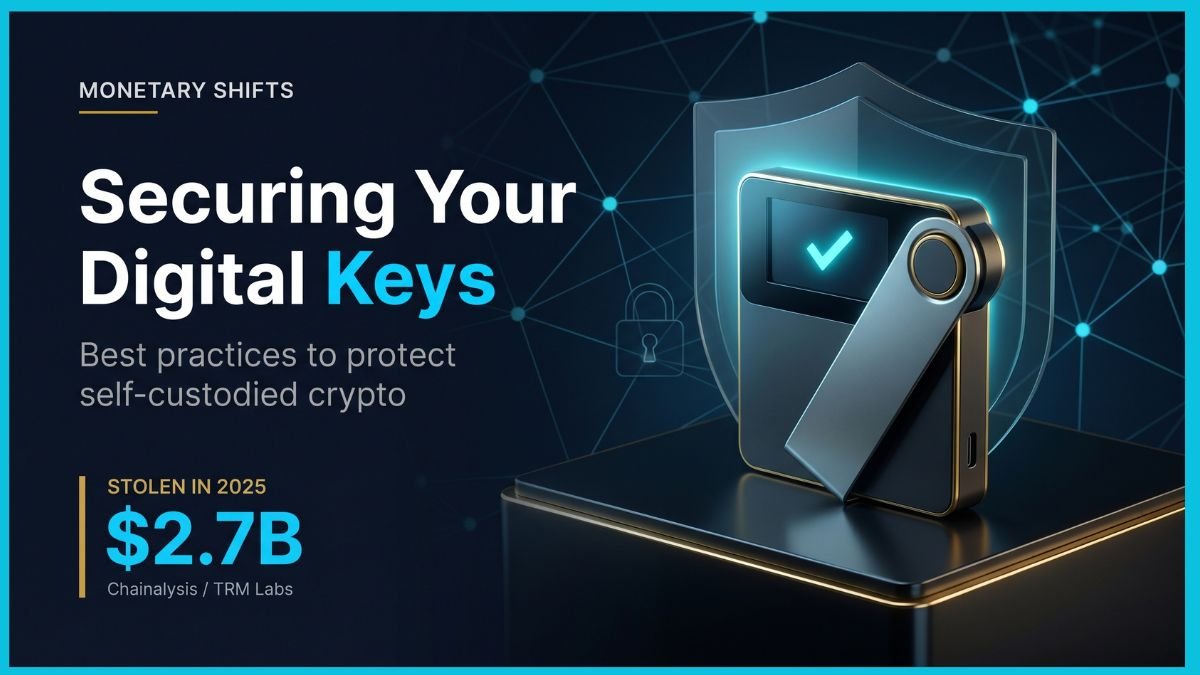
Crypto wallet security is the set of practices that keep the private keys controlling your digital assets out of an attacker’s reach. It works by storing keys offline, verifying every transaction on a trusted screen, and protecting your recovery phrase. It matters because, on most blockchains, a stolen key means an irreversible loss with no bank or insurer to reverse it.
Introduction
Self-custody puts you in charge of your own money, but it also makes you your own security department. In 2025, blockchain forensics firm Chainalysis tracked roughly $2.7 billion in stolen crypto, and personal wallet compromises surged to around 158,000 incidents affecting at least 80,000 individual victims. The threat is no longer aimed only at exchanges; ordinary holders are now squarely in the crosshairs. Strong crypto wallet security is what separates investors who keep their coins from those who learn the meaning of “not your keys, not your coins” the hard way. This crypto wallet security guide explains how wallets actually protect your assets, the practices institutional desks and serious self-custodians rely on, and the mistakes that drain wallets fastest. It sits within the broader story of how digital assets are reshaping custody, settlement, and ownership across the global financial system — and gives you a defensible playbook you can apply today. For readers still mapping the broader landscape, our guide to the cryptocurrency market for beginners places self-custody within the full market context.
Why Crypto Wallet Security Is Different From Bank Security
Traditional finance is built on reversibility. A fraudulent card charge can be disputed, a wire can sometimes be recalled, and a forgotten password can be reset by customer support. Public blockchains were deliberately designed to remove those intermediaries, which means transactions are final and pseudonymous by default. That same property that makes crypto censorship-resistant also makes theft permanent.
A crypto wallet does not actually “store” your coins. Your assets live on the blockchain; the wallet is a tool that manages the private keys that authorize movement of those assets. Whoever controls the keys controls the coins. This is why effective crypto wallet security rests on key management — not password strength or two-factor codes alone. Understanding this distinction is the foundation that the broader shift toward blockchain in finance is built on, where custody of cryptographic keys replaces custody of account balances.
The stakes are rising alongside adoption. Chainalysis reported that stolen funds from crypto services exceeded $2.17 billion in just the first half of 2025, already surpassing the entire 2024 total, with the $1.5 billion Bybit exchange breach accounting for the majority. Even sophisticated institutions with professional security teams are being compromised through private-key and signing-process failures — a reminder that the discipline of crypto wallet security described below applies at every level.
What Is a Crypto Wallet?
A crypto wallet is a tool that generates and safeguards the private keys used to authorize blockchain transactions. It does not hold coins directly; the assets remain on-chain, while the wallet proves ownership through cryptographic signatures. Wallets come in two broad forms: hot wallets, which stay connected to the internet, and cold wallets, which keep keys offline for stronger protection. This hot-versus-cold distinction is the starting point of crypto wallet security.
The practical security difference between these two forms is large enough that choosing correctly is often the single most important decision a holder makes. Hot wallets — mobile apps, browser extensions, and exchange wallets — are convenient for daily activity but keep keys in the memory of a networked device, exposing them to malware and phishing. Cold wallets isolate keys from the internet entirely. For a deeper breakdown of when each is appropriate, the comparison of cold storage vs hot wallet walks through the trade-offs holding amount by holding amount.
Hardware Wallets and the Power of Offline Signing
For any meaningful balance, a hardware wallet remains the gold standard of crypto wallet security and self-custody in 2026. These dedicated devices store private keys inside a tamper-resistant Secure Element chip and never expose those keys to the connected computer or phone. Instead, they use offline signing: an unsigned transaction is sent to the device, you verify the details on the device’s own screen, and the signature is produced internally and sent back. Even a fully malware-infected computer cannot extract the key.
When selecting a device, security researchers point to Secure Element chips certified to CC EAL5+ or EAL6+, which are engineered to resist physical tampering and side-channel attacks. Established options such as Ledger and Trezor have long track records, while a newer generation of wallets uses approaches like Shamir’s Secret Sharing and multi-party computation to eliminate the single seed phrase as a point of failure.
Two operational habits matter as much as the hardware itself, and both are central to crypto wallet security. First, buy only from the official manufacturer. According to guidance compiled by Bitget, if a device arrives with a pre-written recovery phrase or broken tamper-evident seals, it is compromised and must never be used — a legitimate device always generates a fresh seed on first boot. Second, embrace clear signing: modern devices that display a transaction’s actual permissions in plain language let you catch a malicious “set approval for all” request before you authorize it. The risk of blindly signing contract approvals is now one of the most common ways even hardware-wallet users lose funds.
Protecting Your Seed Phrase: The Master Key
When you set up a self-custody wallet, it generates a seed phrase — typically 12 or 24 words — that is a human-readable representation of your private keys. Anyone who obtains it can recreate your wallet and drain it instantly; anyone who loses it permanently loses access. It is, in the words of one widely cited guide from Ledger, the single most sensitive piece of information in your entire setup.
A small set of rules governs seed-phrase hygiene, and it is the core of practical crypto wallet security — violating any one of these rules is how most personal wallets are lost:
- Never digitize it. Do not type the phrase into any internet-connected device, photograph it, email it, or store it in cloud storage. A single exposure can be enough. In April 2026, South Korean authorities reportedly lost $4.8 million in seized crypto because a photo of a hardware wallet’s seed phrase leaked.
- Record it physically. Pen and paper is the baseline; engraving on stainless steel or titanium plates protects against fire, flood, and corrosion, with metal backups rated to survive temperatures above 1,400°C.
- Store it secretly and redundantly. Keep backups in separate secure locations, such as a fireproof safe and a safety deposit box, so a single disaster cannot wipe out both the device and its recovery.
- Consider a passphrase. An optional “25th word” adds a layer of encryption: even someone who finds your 24 words cannot access funds without the passphrase held only in your memory.
- Never share it. No legitimate wallet provider or exchange will ever ask for your seed phrase. Any message that does is a phishing attempt.
What Is a Wrench Attack?
A wrench attack is a physical-coercion theft in which an attacker uses violence or the threat of it to force a crypto holder to surrender keys or transfer funds directly. Unlike remote hacking, it bypasses all digital defenses by targeting the person rather than the device. Chainalysis found these attacks correlate with bitcoin’s price, rising opportunistically during high-value periods.
This category of risk reframes crypto wallet security around personal privacy. Holders are advised to avoid publicly disclosing the size of their portfolios, keep large balances in setups that cannot be moved under duress — such as multi-signature or time-locked configurations — and maintain a small, plausible “decoy” balance for worst-case scenarios. The reported number of physical attacks in 2025 was already roughly double the next-highest year on record, and Chainalysis notes many such incidents go unreported.
Defending Against Phishing, Malware, and Social Engineering
The majority of personal wallet compromises do not involve breaking cryptography — they involve tricking the owner, which is why crypto wallet security is as much behavioral as technical. Attackers in 2025 increasingly deployed sophisticated social-engineering schemes, deepfake videos, and one-click malware to compromise individual wallets. The defenses are procedural and habitual:
| Threat | How it works | Primary defense |
|---|---|---|
| Phishing | Fake sites or messages prompt you to enter your seed phrase or connect a wallet | Never enter a seed phrase online; bookmark official sites; verify URLs |
| Malicious approvals | A dApp requests broad token-spending permissions | Use clear signing; revoke unused approvals; limit allowances |
| Malware / keyloggers | Software scans a device for keys or intercepts input | Keep keys on hardware; maintain device hygiene; dedicated devices |
| Address poisoning | Attacker seeds your history with a look-alike address | Verify the full address on the hardware screen before sending |
| Impersonation | “Support staff” or fake recovery tools request access | Reputable providers never ask for your seed phrase |
A useful discipline borrowed from institutional security is defense in depth: assume any single layer can fail and stack independent protections so that no one mistake is fatal. This layered approach is the practical heart of crypto wallet security. Pair hardware-backed signing with strict device hygiene, train yourself to scrutinize every approval prompt, and treat unsolicited contact as hostile by default. Encouragingly, the data suggest these habits work — despite a rebound in total value locked across decentralized finance, hack losses stayed suppressed through 2024 and 2025, which Chainalysis attributes partly to improved security practices making a measurable difference.
Advanced Custody: Multisig, MPC, and Inheritance Planning
As balances grow, a single seed phrase becomes a single point of failure, and crypto wallet security increasingly depends on distributing trust. Two architectures address this. Multi-signature (multisig) wallets require multiple independent keys — for example, two of three hardware devices — to authorize any transaction, so the compromise or loss of one key is not catastrophic. Multi-party computation (MPC) instead shards a key mathematically across parties, enabling flexible recovery and spending controls without ever assembling a complete key in one place. Both are increasingly used by serious individual holders, not just institutions, and they mirror the custody models emerging across regulated digital-asset markets overseen by bodies such as the U.S. Securities and Exchange Commission.
Inheritance planning is the most overlooked element of crypto wallet security. Because there is no customer-service line to recover a deceased holder’s keys, assets without a succession plan are effectively burned. Best practice is to document your setup thoroughly, create clear recovery instructions for trusted next-of-kin, and — ideally — have them practice the recovery process before it is ever needed. The same finality that protects your coins from seizure also means no one can retrieve them on your behalf without preparation.
People Also Ask
Are personal crypto wallets becoming more vulnerable to hacks? Yes. Chainalysis recorded a surge in personal wallet compromises in 2025, reaching roughly 158,000 incidents and affecting at least 80,000 unique victims, which makes crypto wallet security more important for individuals than ever. Attackers are targeting more individuals while stealing smaller amounts per victim, with Ethereum and Tron showing the highest theft rates per user. The trend reflects rising adoption and increasingly sophisticated social engineering aimed at everyday holders.
Is a hardware wallet really necessary for crypto? For any meaningful balance, yes — a hardware wallet is the cornerstone of crypto wallet security. Hardware wallets keep private keys offline inside a tamper-resistant chip and sign transactions internally, so even a malware-infected computer cannot extract the key. Most holders use a small hot-wallet balance for daily activity while keeping the large majority of their portfolio — often 90% or more — in cold storage on a hardware device.
Can someone steal my crypto if they have my seed phrase? Yes, instantly and irreversibly. The seed phrase regenerates your private keys, so anyone who obtains it can recreate your wallet and move all funds. This is why protecting the seed phrase is the central rule of crypto wallet security; it must never be typed into an online device, photographed, or shared. Reputable wallet providers and exchanges will never ask for it under any circumstances.
What happens if I lose my hardware wallet? You do not lose your crypto, as long as you have your seed phrase. The assets live on the blockchain, not the device. You can restore full access by entering your recovery phrase into a new compatible wallet. This is precisely why protecting the seed phrase — not the hardware — is the central task of self-custody.
How much crypto theft happens overall? In 2025, firms including Chainalysis and TRM Labs estimated roughly $2.7 billion in stolen crypto, driven heavily by state-linked actors and the record $1.5 billion Bybit breach. Even so, illicit activity remains under 1% of total on-chain volume, meaning the vast majority of blockchain transactions are legitimate.
Conclusion
Crypto wallet security comes down to one principle: control of your keys is control of your coins, and that control is unforgiving of mistakes. The most effective crypto wallet security playbook is also the simplest — keep the bulk of your holdings in cold storage on a verified hardware wallet, protect your seed phrase physically and never digitally, verify every transaction on a trusted screen, and treat unsolicited contact as a threat. As theft increasingly targets individuals rather than exchanges, these crypto wallet security habits are no longer optional. Start by auditing where your keys live today, then move anything significant offline. Your next step: review whether your current storage matches the size of what you are protecting.
Frequently Asked Questions
What is the difference between a custodial and a non-custodial wallet? A custodial wallet — typically provided by an exchange like Coinbase or Binance — means a third party holds your private keys and can freeze, recover, or in worst cases lose your funds. A non-custodial (self-custody) wallet means you alone control the keys; no company can seize or restore them. Custodial wallets offer convenience and account recovery at the cost of counterparty risk, which is what holders mean by “not your keys, not your coins.” Non-custodial wallets offer full ownership and censorship resistance but place the entire burden of security and backup on you. Most serious holders treat self-custody as the foundation of crypto wallet security for long-term storage and limit custodial exposure to funds they are actively trading.
Should I keep my crypto on an exchange or in my own wallet? Exchanges are reasonable for assets you are actively trading, but they carry counterparty risk: if the platform is hacked, becomes insolvent, or freezes withdrawals, you can lose access. The 2025 Bybit breach, the largest crypto theft on record at $1.5 billion, underscored that even major platforms remain vulnerable. A widely used crypto wallet security strategy is to keep only a small, working balance on an exchange or hot wallet for liquidity, while securing the majority of holdings in self-custody on a hardware wallet. This balances the convenience of quick access against the security of offline storage.
How often should I review my wallet security? Treat crypto wallet security as ongoing maintenance rather than a one-time setup. Periodically revoke unused token approvals and spending allowances granted to decentralized applications, since these can be exploited long after you stop using a service. Update your hardware wallet’s firmware and companion apps from official sources only. Re-verify that your seed phrase backups are intact, legible, and stored securely, and confirm that your inheritance instructions remain current. As your portfolio grows, reassess whether you have outgrown a single-key setup and should move toward multisig or MPC.
Is it safe to connect my wallet to decentralized applications? It can be, but each connection introduces risk, and managing that risk is a key part of crypto wallet security. The main danger is not the connection itself but the transaction approvals you sign afterward — a malicious “set approval for all” request can grant unlimited spending power over a token. Use a hardware wallet with clear signing so you can read what each transaction actually authorizes, connect only to applications you have independently verified, and limit token allowances rather than granting unlimited ones. Periodically reviewing and revoking old approvals closes a common attack vector that drains funds well after the original interaction, and is a habit that strong crypto wallet security depends on.
Important Notice: This article is for educational and informational purposes only and does not constitute financial, investment, legal, or tax advice. Cryptocurrency involves significant risk, including the potential loss of your entire holdings. Always conduct your own research and consult a qualified professional before making decisions about digital-asset custody or investment.

About Financial Cryptarch
Financial Cryptarch is the Founder of Criptocurrencie and a finance professional with over 15 years of experience in Accounting and Corporate Finance. Holding a Bachelor’s Degree in Accounting and an MBA in Corporate Finance, he focuses on cryptocurrencies, macroeconomics, global finance, and international geopolitics, helping readers understand the forces shaping money, markets, and economic power.


