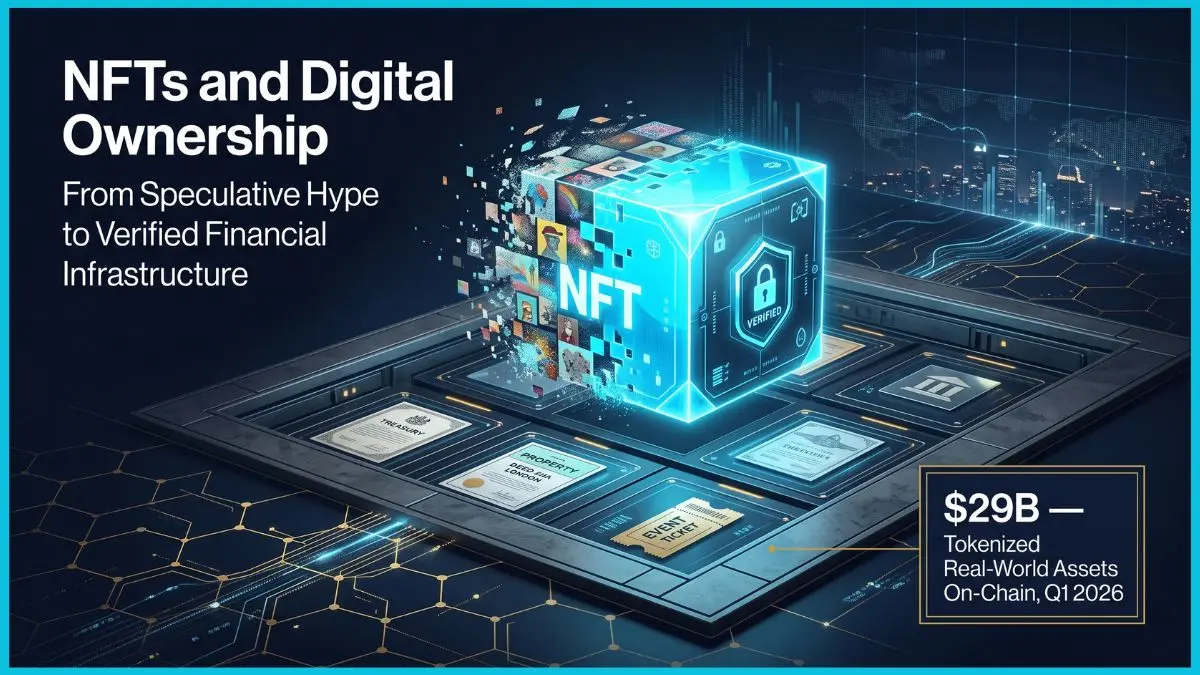
NFTs and digital ownership use blockchain to assign a unique, verifiable record of who controls a digital or real-world asset. After the speculative collapse of 2022, the technology matured into infrastructure for ticketing, loyalty, gaming, and tokenized assets. The hype died; the underlying ownership model did not.
Introduction
Few topics in digital finance divide opinion like NFTs and digital ownership. To critics, non-fungible tokens were the defining bubble of the last cycle — overpriced profile pictures that lost almost all their value. To proponents, the same technology quietly became the settlement layer for verifiable digital property rights. Both views contain truth. By 2023, one widely cited analysis found roughly 95% of NFT collections had effectively zero monetary value, and the speculative frenzy that pushed Pak’s The Merge to $91.8 million in late 2021 evaporated almost entirely.
Yet the market did not vanish. Industry estimates place the global NFT market between $43 billion in 2025 and a projected $60.82 billion in 2026, even as the speculative mania faded. The question is no longer whether NFTs survived, but what they became. This article separates the durable signal from the discredited noise, examining where digital ownership delivers genuine economic function and where it remains a solution in search of a problem.
What Is an NFT and What Does Digital Ownership Actually Mean?
A non-fungible token is a unique cryptographic record stored on a blockchain that points to a specific asset and certifies who controls it. Unlike a bitcoin, which is interchangeable with any other bitcoin, each NFT is distinct and cannot be swapped one-for-one. That uniqueness is what allows it to represent a deed, a ticket, a membership, or a one-of-a-kind artwork.
Digital ownership, in this context, means holding a transferable, independently verifiable claim that does not depend on a single company’s database. Most NFTs are minted on Ethereum, which still anchors roughly 62% of NFT contracts, with Solana and Polygon handling much of the lower-cost activity. The token itself is the proof; the blockchain is the public ledger that makes the claim auditable by anyone. This concept of self-custodied, verifiable ownership connects directly to the broader logic of decentralized finance, where users hold and move assets without a custodial intermediary.
The critical nuance — and the source of most confusion — is what an NFT actually grants. The concept of NFT and digital ownership is often misunderstood here: owning a token often confers control of the on-chain record, not automatic legal title to an underlying physical object or the intellectual property of an image. That gap between digital possession and enforceable legal rights remains one of the most important due-diligence questions for any buyer.
The Hype: What Genuinely Collapsed
The case for skepticism is well documented. NFT trading volume surged from roughly $82 million in 2020 to about $17 billion in 2021, a rise driven by stimulus liquidity, pandemic-era speculation, and celebrity promotion rather than utility. When sentiment reversed, the correction was brutal. By 2023, the dappGambl report analyzing more than 73,000 collections concluded that the average collection was worth nothing and that 79% of all minted collections remained unsold.
Several structural problems amplified the damage. Wash trading — sellers trading with themselves to fabricate demand — inflated apparent volumes. Projects promising metaverse games and utility frequently delivered nothing, and rug pulls became common enough to define the era’s reputation. High-profile corporate experiments also failed: Nike shut down its RTFKT acquisition in 2025, and Adidas’s “Into The Metaverse” collection lost roughly 80% of its value.
This history matters because it explains a lasting reputational drag. As analysts at firms like Chainalysis have repeatedly emphasized, disclosure and verifiable rights are the core issues — buyers frequently did not understand whether they were purchasing access, economic rights, or merely a speculative image. The hype was real, and so was its collapse.
The Revolution: Where Digital Ownership Found Real Function
The more interesting development is what survived the correction. Total NFT transaction volume in 2025 reached an estimated $5.5 billion — well below the peak, but increasingly driven by usage rather than speculation. Active participation grew roughly 80% year-over-year heading into 2026, with the composition of the market unrecognizable from five years earlier.
The clearest signal is enterprise adoption framed around utility, not flipping. Starbucks Odyssey enrolled more than two million members using collectible tokens as a programmable loyalty layer, and Nike’s .SWOOSH platform turned digital ownership into redeemable product access. The lesson from successes and failures alike is consistent: loyalty tokens work when they replace clunky points systems with better user experience, and fail when they are bolted onto hype. Gaming has proven the strongest behavioral fit, where players own in-game assets as functional items rather than speculative collectibles — a use case projected to scale into the tens of billions of dollars.
Ticketing is another area where the economic pain point is obvious. Programmable NFT tickets can reduce fraud and counterfeiting while converting a disposable barcode into a persistent relationship between organizer and fan; by early 2026, NFT-based tickets reportedly captured around 5.3% of major US venue ticket sales. Supply-chain provenance and “digital product passports” for luxury goods extend the same principle of verifiable, transferable authenticity. The thread running through these examples is that the strongest projects increasingly use NFT rails while barely using the word “NFT” in their marketing — a sign of maturity rather than weakness.
Institutional Tokenization and the Convergence with Real Assets
The most consequential shift moves beyond consumer collectibles entirely. The broader logic of representing ownership on-chain has been embraced by the largest names in traditional finance through real-world asset (RWA) tokenization. As of early 2026, the total value of tokenized real-world assets on public blockchains reached roughly $29 billion, a sharp year-over-year increase, with the wider tokenized market exceeding $240 billion when stablecoins are included.
BlackRock’s tokenized money market fund, BUIDL, surpassed $2.5 billion in assets and began trading on a decentralized exchange in February 2026 — placing a regulated institutional product directly onto public blockchain rails. BlackRock CEO Larry Fink has argued that essentially every stock and bond could eventually be tokenized, and consulting estimates for the tokenized-asset market by 2030 range from McKinsey’s $2 trillion to Boston Consulting Group’s far larger projections. This institutional momentum reframes digital ownership from a retail curiosity into potential financial-market infrastructure, with implications for blockchain in finance that extend well past digital art.
Regulatory clarity has accelerated this convergence. In March 2026, a joint SEC and CFTC interpretation sorted crypto assets into defined categories — including digital collectibles, which encompass NFTs, and digital securities — marking the first coordinated federal classification framework, while the EU’s MiCA regime provided parallel clarity in Europe. For institutions, predictable rules are often the precondition for capital deployment, and this connects digital ownership to the same macro forces shaping crypto adoption more broadly.
What Is a Utility NFT?
A utility NFT is a token whose primary value comes from what it lets the holder do — access an event, unlock membership perks, use an in-game item, or verify product authenticity — rather than from speculative resale. Unlike profile-picture collections priced on hype, utility NFTs derive worth from a function the holder actually uses, which tends to produce more durable, usage-based demand.
People Also Ask
Are NFTs dead in 2026? No. Speculative profile-picture trading collapsed and most 2021-era collections lost nearly all value, but utility-focused NFTs in gaming, ticketing, loyalty, and tokenized assets have continued growing. Active participation rose around 80% year-over-year into 2026. The market is smaller and more grounded in actual usage than at its speculative peak.
Does owning an NFT mean I own the copyright? Usually not. Owning an NFT typically grants control of the on-chain ownership record, not automatic copyright or intellectual-property rights to the underlying image or asset. Rights depend entirely on the specific license attached to the project. Buyers should verify what they are actually acquiring before purchasing.
What is the difference between an NFT and a tokenized real-world asset? An NFT is a unique on-chain token that can represent almost anything, often a digital collectible. A tokenized real-world asset is a blockchain representation of a traditional instrument — a Treasury, bond, or property stake — usually backed by legal structures binding the token to the off-chain asset. Both use similar technology for verifiable ownership.
Why did so many NFT collections lose their value? Most early NFTs were priced on speculation and scarcity rather than function. When liquidity and hype faded, demand evaporated. Analyses found the average collection eventually worth roughly nothing, with the large majority unsold. Projects offering genuine, ongoing utility have generally held value far better than purely speculative ones.
Which blockchain hosts the most NFTs? Ethereum remains the dominant network, anchoring roughly 62% of NFT contracts in 2026. Solana handles a significant share of lower-cost, high-throughput activity at around 18%, with Polygon, Base, and other Layer-2 networks absorbing much of the ticketing and gaming volume where low fees matter most.
Conclusion
So, hype or real revolution? The honest answer is both, in sequence. The speculative NFT bubble was a genuine bubble, and its collapse was deserved. But the underlying capability — verifiable, transferable, self-custodied digital ownership — did not disappear with the JPEG mania. It migrated into ticketing, loyalty, gaming, supply-chain provenance, and most significantly, institutional asset tokenization now measured in the tens of billions of dollars. The lazy version of NFTs is dead; the functional version is becoming financial infrastructure. For anyone evaluating this space, the right question is no longer “what is it worth?” but “what does it actually do?” To go deeper, explore how blockchain in finance is reshaping global markets..
FAQ
How do I verify that an NFT is authentic before buying it? Authenticity verification starts with confirming the smart contract address against the project’s official channels, since scammers routinely deploy copycat contracts. Check the collection on multiple marketplaces and on-chain explorers to confirm minting history, holder distribution, and trading patterns that could indicate wash trading. Review exactly what rights the token grants — access, intellectual property, or economic claims — because these vary entirely by project. For higher-value purchases, examine the team’s track record and whether they are publicly identifiable, as anonymous teams with no history are a recognized warning sign. Treating verification of rights, supply, and contract legitimacy as core due diligence is far more important than reacting to floor-price charts.
Are NFT royalties guaranteed for creators? No. NFT royalties — the percentage a creator receives on secondary sales — are not enforced at the blockchain protocol level by default. They depend on marketplaces choosing to honor and collect them, and several major platforms have made royalties optional to attract traders. This means a creator’s expected royalty stream can shrink or disappear if buyers route sales through marketplaces that do not enforce them. Analysts often describe royalties as a “social layer” rather than a hard contractual guarantee, which introduces real uncertainty into any cash-flow model built around them. Creators seeking reliable royalties increasingly rely on technical enforcement mechanisms or transfer restrictions written directly into the token contract.
How does NFT-based ticketing actually reduce fraud? NFT ticketing assigns each ticket a unique, verifiable on-chain identity that cannot be duplicated, which directly attacks counterfeiting. Because ownership and transfer history are recorded transparently, organizers can see the full chain of custody and can program rules into the ticket itself — such as resale price caps or restrictions on transfers — that traditional barcodes cannot enforce. This converts a one-time disposable barcode into a persistent digital object that can also unlock post-event rewards or future access, deepening the relationship between organizer and attendee. Platforms working in this space have demonstrated measurable adoption, with NFT-linked tickets capturing a growing share of major venue sales. The model works best when the underlying blockchain offers low fees, which is why ticketing has gravitated toward Layer-2 networks.
What role do institutions like BlackRock play in digital ownership? Major institutions have shifted the conversation from speculative collectibles toward tokenizing traditional financial assets on public blockchains. BlackRock’s tokenized money market fund crossed $2.5 billion in assets and began trading on a decentralized exchange in early 2026, demonstrating that regulated products can operate on the same rails as crypto-native assets. This matters because institutional participation brings deep liquidity, legal structuring, and credibility that retail speculation never could. The appeal for these firms is programmable finance: automated settlement, fractional ownership of previously illiquid assets, and the ability to use tokenized instruments as collateral. Their involvement signals that the durable value of digital ownership may lie less in art and more in the efficient settlement of real-world financial assets.
Should NFTs be treated as investments? Treating NFTs primarily as investments carries substantial risk, given that the large majority of past collections lost nearly all value. Where they retain worth, it is increasingly tied to genuine utility — access, membership, in-game function, or asset backing — rather than speculative appreciation. Liquidity is typically thin and uneven, meaning exiting a position can take a long time or require accepting a steep discount. Any allocation should be sized so that a total loss would not damage a broader financial plan, and speculative upside such as future airdrops should be treated as a bonus rather than a base case. This is general information, not financial advice, and individual circumstances differ considerably.
Important Notice
This content is provided for informational and educational purposes only and does not constitute investment, financial, legal, or tax advice. NFTs and tokenized digital assets carry high volatility, the risk of total loss, limited liquidity, and regulatory uncertainty. The intellectual property rights associated with an NFT vary by project and do not always transfer with ownership of the token. Before making any decision, consult a licensed professional and consider your own financial situation.

About Financial Cryptarch
Financial Cryptarch is the Founder of Criptocurrencie and a finance professional with over 15 years of experience in Accounting and Corporate Finance. Holding a Bachelor’s Degree in Accounting and an MBA in Corporate Finance, he focuses on cryptocurrencies, macroeconomics, global finance, and international geopolitics, helping readers understand the forces shaping money, markets, and economic power.


