
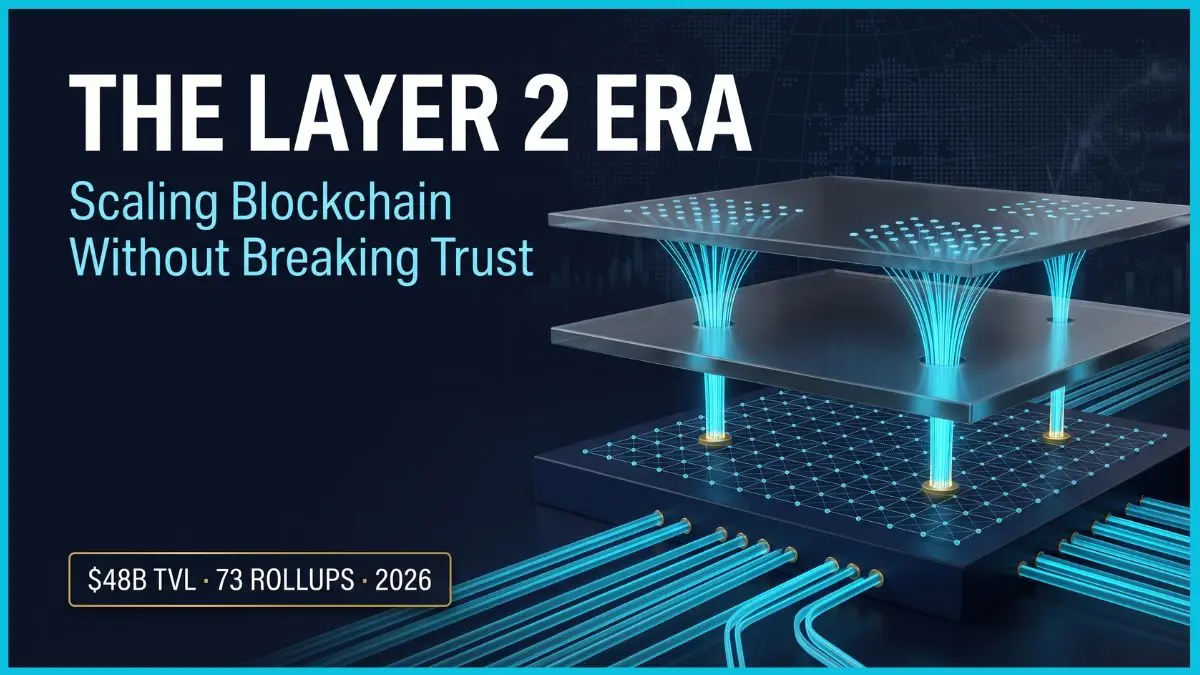
Layer 2 scaling solutions are separate networks built on top of a base blockchain like Ethereum or Bitcoin. These Layer 2 scaling solutions process transactions off the main chain and settle them back to it, delivering faster confirmations and fees often 10 to 100 times cheaper while inheriting the security of the underlying Layer 1.
Introduction
For most of its history, Ethereum faced a hard constraint: the base chain processes only about 15 transactions per second, and Bitcoin fewer still. During periods of heavy demand, fees climbed to tens of dollars and confirmations slowed, pricing out everyday users. Layer 2 scaling solutions emerged as the dominant answer to this problem, moving execution off-chain while preserving the trust guarantees of the settlement layer.
The shift has been dramatic. Layer 2 scaling solutions collectively grew their total value locked from under $4 billion in 2023 to roughly $48 billion by 2026, with L2BEAT tracking 73 active rollups. In 2026, Layer 2 networks are where most Ethereum activity actually happens, and where most stablecoin volume actually settles. Understanding how rollups, payment channels, and related layer 2 scaling solutions work is now essential for anyone evaluating where to build, transact, or hold meaningful value in the digital-asset economy.
What Is a Layer 2 Scaling Solution?
A Layer 2 scaling solution is a protocol that executes transactions away from a base blockchain (Layer 1) and periodically commits the results back to it for final settlement. The Layer 1 remains the ultimate source of truth, while the Layer 2 scaling solution handles throughput. This security inheritance is the defining test that separates a true Layer 2 from a sidechain, which runs its own validator set and security budget.
The economics are straightforward. By batching hundreds or thousands of transactions and posting compressed data back to the base chain, a Layer 2 spreads the fixed cost of Layer 1 settlement across many users. The per-transaction fee falls sharply, often to a fraction of a cent, while each transaction still ultimately relies on Ethereum or Bitcoin as the arbiter of finality. This modular design — execution on Layer 2, settlement and data availability on Layer 1 — has become the central architecture of Ethereum’s roadmap.
Rollups: The Dominant Layer 2 Architecture
Rollups are the most widely adopted category of Layer 2 scaling solution. A rollup executes transactions off-chain, bundles them, and posts the transaction data plus a state commitment back to the base layer. According to the Ethereum Foundation, almost every production Layer 2 in 2026 is a rollup, and almost every rollup is either optimistic or zero-knowledge. The distinction is purely cryptoeconomic: it comes down to how each one proves to the base chain that its batched transactions are valid.
The two families dominate different niches. Optimistic rollups assume every batch is valid and rely on a fraud-proof challenge window — typically seven days — during which anyone can dispute an invalid state. Arbitrum, Base, and Optimism are the market leaders here, and they concentrate the deepest DeFi liquidity. Zero-knowledge (ZK) rollups instead generate a cryptographic validity proof for every batch, which Ethereum verifies in seconds. zkSync Era, Starknet, Linea, and Scroll lead this side, offering faster finality and stronger long-term security assumptions.
Optimistic Rollups in Practice
Arbitrum One remains the largest general-purpose Layer 2 by value, holding roughly $17 billion and about 44% of all Layer 2 total value locked in 2026. It is also the only major rollup to reach L2BEAT Stage 1, meaning it operates permissionless fraud proofs after shipping its BOLD validation system in late 2025. Base, built on Optimism’s OP Stack and integrated with Coinbase’s user base, has grown explosively — from around $2.1 billion in October 2024 to roughly $12.8 billion by May 2026 — finishing 2025 as the top rollup by revenue at $82.6 million.
Zero-Knowledge Rollups in Practice
ZK rollups close their historical weaknesses in 2026. EVM compatibility, once difficult, has matured as zkEVMs improve, and proving costs have fallen as prover hardware advances. The practical advantage is finality: ZK withdrawals to the base layer settle in under an hour, whereas optimistic withdrawals take the full seven-day window unless routed through a third-party bridge that fronts liquidity. This makes ZK rollups attractive for institutional use cases, high-value transactions, and privacy-sensitive applications, and positions them among the most security-conscious Layer 2 scaling solutions available in 2026.
Payment Channels and State Channels
Payment channels are a fundamentally different Layer 2 scaling solution. Rather than batching transactions for a whole network, two or more parties open a direct channel by locking funds on the base chain, then exchange an unlimited number of signed off-chain updates, settling only the opening and closing balances on-chain. The most mature implementation is Bitcoin’s Lightning Network, documented at Bitcoin.org, which operates through bidirectional payment channels secured by penalty mechanisms that punish anyone broadcasting an outdated state.
The Lightning Network has matured into real payment infrastructure and remains the most widely used of all Bitcoin Layer 2 scaling solutions. As of May 2026 it held roughly 5,600 BTC in public channel capacity across more than 41,000 channels, and crossed $1 billion in monthly transaction volume in early 2026. Yet channels carry structural trade-offs. They require participants to lock substantial capital upfront — by some estimates 3 to 5 times more locked value than an equivalent rollup — and both parties must remain online or rely on third-party “watchtowers” to prevent fraud. These constraints keep state channels best suited to high-frequency, low-value payments between known parties rather than general-purpose applications, and they make sound crypto wallet security practices essential for anyone running channel infrastructure.
How Rollups and Channels Differ
Choosing a Layer 2 scaling solution depends heavily on the use case. Rollups support arbitrary smart contracts, DeFi, NFTs, and public applications open to anyone; channels excel only at repeated payments between fixed counterparties. The comparison below summarizes the core differences between these two Layer 2 scaling solutions.
| Feature | Rollups | Payment Channels |
|---|---|---|
| Finality | Minutes to hours (ZK) or up to 7 days (optimistic) | Instant between parties |
| Capital efficiency | Lock $1, transact $100+ | Lock full transaction value upfront |
| Use case | General-purpose dApps, DeFi, trading | High-frequency micropayments |
| Participation | No need to stay online | Both parties must be online |
| Examples | Arbitrum, Base, zkSync, Starknet | Lightning Network, Raiden |
This is why the two coexist rather than compete. Lightning functions as Bitcoin’s payment rail, while rollups serve as Ethereum’s general-purpose execution environment. Each leverages the security of its base layer for a different class of activity.
Why Layer 2 Scaling Matters for Global Finance
The significance of Layer 2 scaling solutions extends well beyond cheaper transactions. As blockchain infrastructure becomes a candidate rail for payments, settlement, and tokenized assets, throughput and cost determine whether these systems can serve institutions and billions of users. The same forces reshaping settlement also underpin the broader story of how blockchain technology is transforming global finance where Layer 2 scaling solutions provide the capacity layer that base chains alone cannot.
The base layer increasingly behaves as a settlement and data-availability layer, securing activity that occurs on Layer 2s. Ethereum’s roadmap reinforces this. The Dencun upgrade in 2024 introduced “blobs,” cutting Layer 2 fees by roughly an order of magnitude, and the Fusaka upgrade activated in December 2025 added PeerDAS, allowing nodes to sample blob data rather than store all of it. According to the Ethereum Foundation, these changes let blob capacity scale continuously, with further reductions in Layer 2 costs expected through 2026 as blob limits rise. Aggregate sector metrics such as total value locked can be tracked in real time on DefiLlama.
That said, the ecosystem faces real risks. Three networks — Base, Arbitrum, and Optimism — now process nearly 90% of all Layer 2 transactions, raising concentration concerns. Most Layer 2s still rely on centralized sequencers run by their core teams, creating censorship and single-point-of-failure risks until sequencer decentralization advances. Investors evaluating exposure to this sector should weigh these structural issues alongside the technology’s clear momentum, much as they would when assessing a diversified crypto portfolio, and should understand the underlying mechanics of decentralized finance (DeFi) that runs on these layers.
People Also Ask
What are the main types of Layer 2 scaling solutions? The two main types of Layer 2 scaling solutions are rollups and channels. Rollups (optimistic and zero-knowledge) batch transactions off-chain and post data or proofs to the base layer. Payment and state channels let parties transact directly off-chain, settling only opening and closing balances. Validiums are a related category that posts proofs on-chain but keeps data on a separate availability layer.
Are Layer 2 networks safe? Layer 2 security inherits from the base layer through its proof system, but security stages vary. As of 2026, only Arbitrum One operates at L2BEAT Stage 1 with permissionless fraud proofs; most others remain at Stage 0, where a multisig council can pause contracts. Most networks also use centralized sequencers, an additional consideration for high-value flows.
Why are Layer 2 transactions cheaper than Layer 1? Layer 2s batch many transactions together and post compressed data back to the base chain, spreading the fixed settlement cost across all users. After Ethereum’s Dencun upgrade introduced blobs, Layer 2 fees fell from $0.50–$3.00 to roughly $0.01–$0.10 per transaction, with further compression expected as blob capacity scales.
What is the difference between a rollup and a sidechain? A rollup posts its transaction data and state commitments back to the base layer, which acts as the final arbiter, inheriting that chain’s security. A sidechain runs its own validator set and security budget, even if it bridges assets to and from the base chain. This security-inheritance test is the working definition that distinguishes the two.
Which Layer 2 is the largest in 2026? Arbitrum One is the largest general-purpose Layer 2 by total value, holding roughly $17 billion and about 44% of all Layer 2 total value locked. Base, built on the OP Stack and integrated with Coinbase, is the fastest-growing chain and the leading rollup by revenue.
Conclusion
Layer 2 scaling solutions have become the operating layer of public blockchains. Rollups provide general-purpose, low-cost execution for DeFi and applications, while payment channels such as the Lightning Network handle high-frequency payments where instant finality matters most. The key takeaway is that these Layer 2 scaling solutions complement rather than replace one another, each leaning on a base chain for security while specializing in a distinct class of activity. For anyone navigating digital assets, the next step is to map a given use case — payments, trading, or building — to the Layer 2 model that fits it best, and to track concentration and decentralization trends as the sector matures.
Frequently Asked Questions
How do Layer 2 scaling solutions inherit security from Layer 1? Layer 2s inherit security by posting transaction data and state commitments back to the base chain, which serves as the ultimate arbiter of finality. For rollups, optimistic systems rely on fraud proofs and a challenge window, while ZK rollups submit cryptographic validity proofs that the base layer verifies directly. If a Layer 2 attempts an invalid state transition, the base chain’s proof system allows it to be challenged or rejected. This inheritance is what distinguishes a genuine Layer 2 from a sidechain, which secures itself with an independent validator set. The strength of that inheritance varies by network and security stage, which is why independent trackers categorize each chain explicitly.
What is a validium and how does it differ from a rollup? A validium is a middle-category scaling design that posts validity proofs to the base layer like a ZK rollup but keeps the underlying transaction data on a separate data-availability layer rather than on the base chain. This trade-off makes validiums cheaper and higher-throughput than standard rollups, because they avoid paying for full on-chain data publication. The cost is weaker security inheritance: if the external data-availability layer fails or withholds data, users may be unable to reconstruct their state or exit. Validiums therefore suit applications that prioritize cost and speed over the strongest possible security guarantees, and they sit between rollups and sidechains on the trust spectrum.
How did Ethereum’s recent upgrades affect Layer 2 fees? Ethereum’s upgrades have steadily lowered Layer 2 costs by improving how cheaply rollups can post data. The Dencun upgrade in 2024 introduced blobs, a dedicated low-cost data lane that cut Layer 2 fees by roughly an order of magnitude. Pectra in 2025 expanded blob capacity further, and the Fusaka upgrade in December 2025 added PeerDAS, which lets nodes sample portions of blob data instead of storing it all. This enables blob capacity to scale through staged increases without requiring full hard forks, with Layer 2 fees expected to keep falling through 2026 as limits rise toward full danksharding.
Can Layer 2 scaling solutions work on Bitcoin as well as Ethereum? Yes. Bitcoin’s primary Layer 2 scaling solution is the Lightning Network, a system of bidirectional payment channels designed for fast, low-cost payments that settle back to the Bitcoin base layer. By 2026 it processed over 12 million monthly transactions across more than 17,000 nodes and crossed $1 billion in monthly volume. Bitcoin’s scaling approach centers on payment rails rather than general-purpose smart contracts, reflecting its design priorities. Ethereum, by contrast, relies mainly on rollups that support arbitrary applications. A growing set of Bitcoin-focused projects also explores rollup-style and statechain designs, but channels remain Bitcoin’s most mature off-chain scaling layer.
What are the biggest risks of using Layer 2 networks? The biggest risks are sequencer centralization, liquidity concentration, and varying security maturity. Most Layer 2s in 2026 still rely on a centralized sequencer operated by the core team, creating censorship and single-point-of-failure exposure. Liquidity is highly concentrated, with three networks processing nearly 90% of Layer 2 transactions, which raises systemic-risk concerns if a dominant chain encounters problems. Security stages also differ: many networks remain at an early stage where a multisig council can pause contracts. Users should also account for withdrawal delays on optimistic rollups and the capital lock-up and online requirements of payment channels.
Aviso Importante: Este conteúdo tem finalidade exclusivamente educacional e informativa e não constitui aconselhamento financeiro, de investimento, jurídico ou tributário. Criptomoedas e ativos digitais envolvem risco elevado e volatilidade significativa. Faça sua própria pesquisa e consulte um profissional licenciado antes de tomar decisões de investimento.

About Financial Cryptarch
Financial Cryptarch is the Founder of Criptocurrencie and a finance professional with over 15 years of experience in Accounting and Corporate Finance. Holding a Bachelor’s Degree in Accounting and an MBA in Corporate Finance, he focuses on cryptocurrencies, macroeconomics, global finance, and international geopolitics, helping readers understand the forces shaping money, markets, and economic power.


