To choose a crypto exchange safely in 2026, prioritize platforms with regulatory licensing, audited proof of reserves, segregated customer funds, and a dedicated protection fund. Verify security history, withdrawal reliability, and fee transparency. The safest crypto exchange is one that lets you confirm—rather than trust—that your assets are fully backed one-to-one on-chain.
Introduction
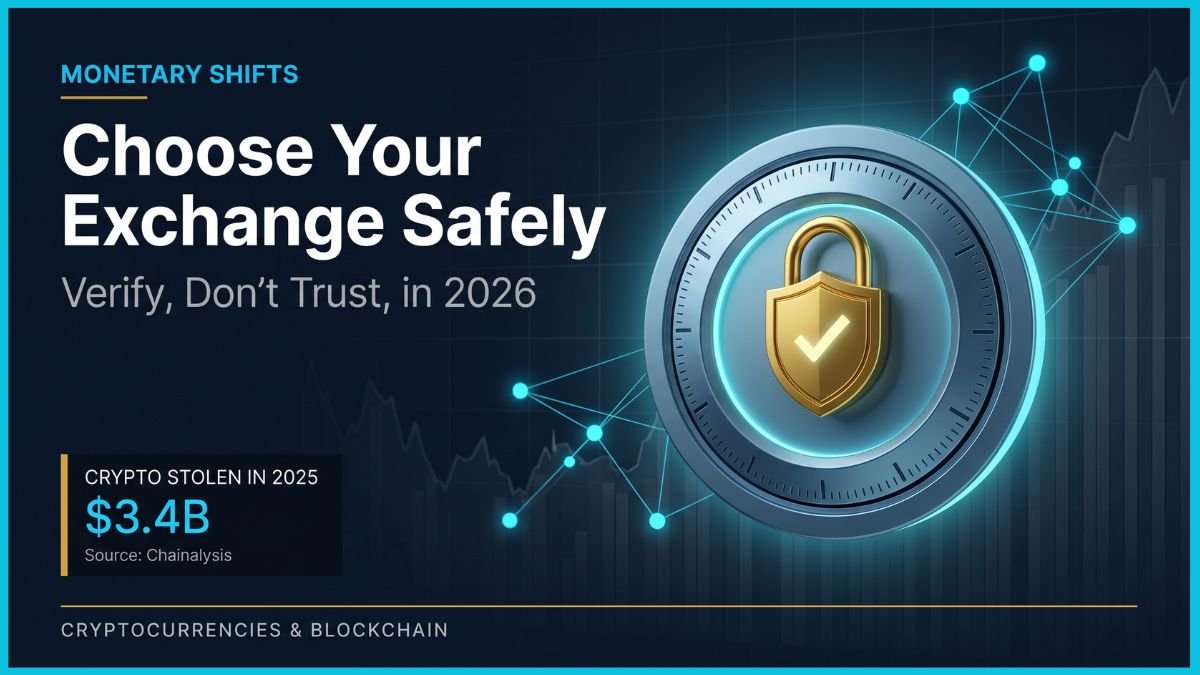
Knowing how to choose a crypto exchange is no longer an optional skill—it is the single most consequential decision a new investor makes. The collapse of FTX in November 2022 erased an estimated $8.9 billion in customer funds and reframed the entire industry around one principle: verify, don’t trust. The lesson was reinforced in February 2025, when the Bybit breach drained roughly $1.5 billion in a single day, the largest digital-asset heist ever recorded. With total crypto theft reaching $3.4 billion across 2025 according to Chainalysis, the crypto exchange you select determines whether your capital is protected by audited reserves and regulatory oversight—or exposed to the same structural failures that destroyed FTX. This guide breaks down the security, regulatory, and operational criteria that separate institutional-grade exchanges from high-risk venues, so you can evaluate any platform against a consistent, evidence-based framework before you deposit a single dollar.
What Is a Crypto Exchange?
A crypto exchange is a platform that lets users buy, sell, and trade cryptocurrencies, acting as the gateway between traditional money and digital assets. Centralized exchanges (CEXs) hold custody of user funds and execute trades internally, while decentralized exchanges (DEXs) let users trade directly from self-custodied wallets. The custody model your crypto exchange uses defines your risk exposure entirely.
The distinction matters because custody is where most catastrophic losses originate. When you deposit funds on a centralized exchange, you surrender direct control of your private keys—the platform holds them on your behalf. This is convenient, but it concentrates risk: if the exchange is hacked, mismanaged, or fraudulent, your assets are exposed. Understanding this trade-off is the foundation of every safe exchange decision, and it connects directly to the broader question of cold storage vs hot wallet custody that every serious investor eventually faces.
Why Exchange Security Became the Defining Issue of the Cycle
The post-FTX era rewired investor priorities. Before 2022, choosing a crypto exchange meant comparing trading features, token listings, and fee structures. Today the question of how to choose a crypto exchange centers on transparency and solvency. The shift is measurable: following FTX’s failure, the majority of centralized exchanges adopted proof-of-reserves protocols to retain user trust, a practice that academic researchers now describe as a core “guardian of trust” in a trust-minimizing system.
The threat landscape explains the urgency. In 2025, illicit actors stole $3.4 billion across roughly 150 hacks, but the concentration is what alarms security researchers—the top three incidents accounted for 69% of all service-side losses. Critically, the nature of attacks has changed. According to TRM Labs, adversaries have “moved up the stack,” targeting operational infrastructure—signing keys, wallet orchestration, and custody controls—rather than smart-contract code. The Bybit breach was not a flaw in blockchain technology; it was a compromise of the exchange’s signing infrastructure through sophisticated social engineering. This is why evaluating an exchange’s internal security architecture now matters as much as evaluating the assets it lists.
State-sponsored actors have intensified this pressure. Chainalysis attributed $2.02 billion of 2025’s stolen funds to North Korea-linked groups—a 51% year-over-year increase that pushed their cumulative total to $6.75 billion. For everyday users, the implication is direct: the crypto exchange holding your funds is a high-value target for some of the most capable threat actors on the planet, and only platforms with genuine institutional security discipline can withstand that pressure. This is precisely why a careful crypto exchange evaluation now begins with security architecture rather than with trading perks.
The Seven Criteria for Evaluating a Crypto Exchange
Choosing a safe crypto exchange comes down to a repeatable checklist. Apply these seven criteria to any crypto exchange before depositing funds.
1. Regulatory licensing. A regulated exchange operates under enforceable rules for capital adequacy, fund segregation, and anti-money-laundering compliance. The European Union’s Markets in Crypto-Assets (MiCA) framework, fully effective since 2024, established harmonized licensing across member states, while jurisdictions like Singapore, Japan, and Dubai (through VARA) have built comparable regimes. Check which authorities a platform answers to.
2. Proof of reserves. The gold standard is a Merkle-tree proof-of-reserves audit that lets you cryptographically verify your own holdings are backed one-to-one on-chain. Leading platforms now publish these monthly. An exchange that refuses third-party attestation is signaling exactly the opacity that defined FTX.
3. Fund segregation. Customer assets must be held separately from corporate operating capital. FTX’s fatal flaw was commingling user deposits with risky bets at its affiliated trading firm, Alameda Research. Confirm the platform contractually segregates client funds.
4. Protection fund. A dedicated reserve—funded independently of operational capital—compensates users in the event of a breach. Binance’s SAFU fund exceeds $1 billion; other major platforms maintain funds in the hundreds of millions. This is the closest crypto equivalent to deposit insurance.
5. Security track record. Research the platform’s incident history. How did it respond to past breaches? Did it make users whole? A transparent post-incident response is more reassuring than an unblemished but unexamined record.
6. Withdrawal reliability. The earliest warning sign of insolvency is friction on withdrawals. Sudden limits, unexplained delays, or “maintenance” on the withdrawal function are red flags that historically preceded collapse.
7. Fee transparency. Hidden spreads, opaque conversion rates, and undisclosed withdrawal fees erode returns. A trustworthy exchange publishes a clear, complete fee schedule.
These criteria gain weight when paired with strong personal habits. Even the safest exchange cannot protect you from a compromised account, which is why pairing platform selection with rigorous crypto wallet security practices is non-negotiable.
FTX vs. the 2026 Standard: What Changed
| Criterion | FTX (2022) | 2026 Best Practice |
|---|---|---|
| Proof of reserves | None | Monthly Merkle-tree audits, on-chain verifiable |
| Fund segregation | Commingled with Alameda | Contractually segregated |
| Governance | No independent board; QuickBooks accounting | Independent oversight, enterprise systems |
| Protection fund | None | $300M–$1B+ dedicated reserves |
| Regulatory status | Minimal oversight | MiCA, VARA, and equivalent licensing |
| Investor posture | “Trust us” | “Verify us” |
The table captures the structural transformation. FTX operated with no proper board of directors, managed billion-dollar flows on basic accounting software, and approved payments through informal chat messages. The 2026 crypto exchange standard demands enterprise governance, audited transparency, and capital buffers. Academic analysis suggests exchanges should hold additional reserves of 6% to 14% above liabilities to withstand market stress—a buffer that didn’t exist anywhere in 2022.
Centralized vs. Decentralized: Matching the Venue to Your Needs
Centralized exchanges remain the entry point for most users because they offer fiat on-ramps, deep liquidity, and customer support. Their trade-off is custodial risk. Decentralized exchanges eliminate custodial risk by letting you trade from your own wallet, but they shift the entire security burden onto you—a single signing mistake or malicious contract approval can be irreversible.
For most new investors, a well-regulated centralized crypto exchange with audited reserves is the practical choice for buying and converting assets, while a self-custody wallet holds long-term positions. This hybrid approach—transacting on a vetted CEX while storing meaningful balances off-exchange—has become the consensus best practice. It reflects a broader truth running through institutional adoption and the macro forces reshaping digital assets, themes explored in depth in our pillar guide to the cryptocurrency market for beginners. The exchange is a tool for access; it should rarely be your vault.
People Also Ask
Is it safe to keep crypto on an exchange? Keeping crypto on a reputable, audited crypto exchange is far safer in 2026 than it was in 2022, thanks to proof-of-reserves protocols and protection funds. However, an exchange controls your private keys, so for large or long-term holdings, transferring assets to a self-custody wallet remains the safest practice. Use exchanges for trading, not long-term storage.
What is proof of reserves and why does it matter? Proof of reserves is a cryptographic audit—typically using a Merkle tree—that demonstrates an exchange holds enough assets to cover all customer deposits one-to-one. It lets users independently verify their balance is backed on-chain. It matters because it directly addresses the opacity that allowed FTX to misuse customer funds undetected for years.
How do I know if a crypto exchange is regulated? Check the platform’s official website and regulatory disclosures for named licenses, then verify them on the regulator’s public register. Look for MiCA authorization in the EU, VARA licensing in Dubai, or registration with national financial authorities. A regulated exchange names its supervisors clearly; vague or unverifiable claims are a warning sign.
What are the warning signs of an unsafe exchange? The clearest red flags are withdrawal delays or restrictions, absence of proof-of-reserves audits, guaranteed-return promises, unclear fund custody, and an anonymous or inexperienced management team. Sudden “maintenance” on withdrawals historically preceded major collapses. When transparency is missing, assume the risk is present.
Are decentralized exchanges safer than centralized ones? Decentralized exchanges remove custodial risk because you keep your own keys, but they introduce different dangers: irreversible transaction errors, malicious smart contracts, and no customer support. They are not inherently safer—they shift the security burden to the user. The right choice depends on your technical skill and the size of your position.
Conclusion
Choosing a crypto exchange safely in 2026 means applying a consistent, evidence-based framework rather than trusting marketing claims. Prioritize regulatory licensing, audited proof of reserves, segregated funds, and a genuine protection fund—and treat withdrawal reliability and fee transparency as ongoing tests. The central lesson of FTX and Bybit is that crypto exchange security is now a competitive differentiator, not a given. The safest path forward pairs a vetted, transparent exchange for access with self-custody for meaningful holdings. Start by auditing your current platform against the seven criteria above, and move your strategy from “trust” to “verify.”
Important Notice
This article is for educational and informational purposes only and does not constitute financial, investment, legal, or tax advice. Cryptocurrency markets are volatile and carry substantial risk of loss. Exchange security practices, regulatory status, and protection funds can change at any time; always verify current details directly with the platform and relevant regulators before depositing funds. Conduct your own research and consult a licensed financial professional before making investment decisions.
FAQ
What is the safest type of crypto exchange in 2026? The safest exchanges in 2026 are regulated centralized platforms that publish monthly proof-of-reserves audits, contractually segregate customer funds from corporate capital, and maintain a substantial dedicated protection fund. These features replicate the transparency and capital safeguards of traditional finance while preserving access to digital assets. No exchange is risk-free, but platforms combining MiCA-level or VARA-level licensing with on-chain verifiable reserves represent the current institutional standard. The key behavioral shift is verification: the safest platforms let you confirm your assets are backed rather than asking you to take their word for it.
How much of my crypto should I keep on an exchange? A widely followed principle is to keep only the funds you are actively trading on an exchange and move long-term holdings to self-custody. Exchanges are custodial by design, meaning the platform controls your private keys, so any amount you hold there carries counterparty risk. For day-to-day buying, selling, and converting, a reputable exchange is appropriate. For positions you intend to hold for months or years, transferring to a hardware wallet sharply reduces exposure to exchange-level breaches or insolvency. Diversifying storage across a vetted exchange and self-custody is the consensus practice among experienced investors.
Can a regulated exchange still get hacked? Yes. Regulation reduces but does not eliminate security risk. The 2025 Bybit breach demonstrated that even sophisticated, well-resourced platforms can be compromised through advanced social engineering targeting their signing infrastructure rather than the blockchain itself. Regulation primarily protects against fraud, fund commingling, and insolvency by enforcing capital and segregation rules; it does not make a platform immune to technical attack. This is why a dedicated protection fund matters so much—it provides a capital backstop to compensate users when a breach occurs despite strong defenses. Layered protection, not a single safeguard, is the goal.
What happened to FTX customers, and what does it teach about exchange choice? FTX collapsed because it secretly misused customer deposits to cover losses at its affiliated trading firm, leaving a multibillion-dollar shortfall. Through a lengthy bankruptcy and asset-recovery process, most creditors are being repaid based on the November 2022 dollar value of their claims—though that valuation excluded subsequent crypto price gains. The lesson is structural: opacity, weak governance, and fund commingling are fatal. An exchange that cannot prove segregation and solvency on demand should be avoided regardless of its brand, size, or marketing. Verification of reserves and clear custody arrangements are non-negotiable.
Do protection funds actually compensate users after a hack? Protection funds are designed to compensate users following security incidents, and their effectiveness depends on size, governance, and transparency. Major platforms maintain funds ranging from several hundred million to over a billion dollars, capitalized independently from operating reserves and earmarked specifically for user protection. They function as the crypto industry’s closest equivalent to deposit insurance. However, they are not a legal guarantee, and coverage terms vary by platform. Before relying on one, confirm the fund’s size, how it is funded, and the conditions under which it pays out. A transparent, well-governed fund is a meaningful safeguard; a vaguely described one is not.

About Financial Cryptarch
Financial Cryptarch is the Founder of Criptocurrencie and a finance professional with over 15 years of experience in Accounting and Corporate Finance. Holding a Bachelor’s Degree in Accounting and an MBA in Corporate Finance, he focuses on cryptocurrencies, macroeconomics, global finance, and international geopolitics, helping readers understand the forces shaping money, markets, and economic power.


