
A cinematic editorial illustration representing DeFi yield farming risks through a futuristic digital vault with fracturing cyan yield streams and gold accents against a deep navy blue background.

DeFi Yield Farming Risks: High Rewards and the Hidden Dangers Investors Overlook

DeFi yield farming risks are the financial and technical dangers investors face when depositing crypto into decentralized protocols to earn yield. They include impermanent loss, smart contract exploits, token-price collapse, and liquidity traps. Understanding these risks matters because advertised returns rarely reflect the true probability of losing capital.

Few corners of decentralized finance attract attention as quickly as yield farming. The promise is simple and seductive: deposit idle crypto into a protocol, earn double-digit returns, and let compounding do the rest. Yet the gap between an advertised annual percentage yield and the money an investor actually keeps can be enormous. According to DefiLlama, total value locked across DeFi fell roughly 37% in the first half of 2026 to about $72 billion, a reminder that capital in these protocols is far from stable. Behind every attractive yield sits a layered structure of exposures that newcomers consistently underestimate. This guide examines the real DeFi yield farming risks, the mechanics that produce them, and the data investors should weigh before committing funds. read more

Continue Reading...
A minimalist editorial financial illustration of a diversified crypto portfolio shown as a concentric donut chart on a deep navy background with electric cyan and gold accents.

Diversified Crypto Portfolio: How to Build One Step by Step

A diversified crypto portfolio spreads capital across assets with different risk profiles—a Bitcoin and Ethereum core, large-cap altcoins, and a stablecoin buffer—to reduce volatility and improve risk-adjusted returns. It works because no single position can sink the whole book, and disciplined allocation, not market timing, drives long-term results.

Building a diversified crypto portfolio is the difference between surviving a full market cycle and getting wiped out in a single drawdown. In mid-2026, the total crypto market capitalization sits near $2.15 trillion with Bitcoin dominance around 55.8%, according to data from CoinGecko. That backdrop—a Bitcoin-led market with elevated dominance—rewards structure over speculation. This guide walks through a practical, step-by-step framework drawn from institutional research, showing how to size your core, layer in growth and high-risk satellites, hold a stablecoin reserve, and rebalance with discipline. The goal is a portfolio that compounds across regimes rather than one that chases the day’s hottest token. read more

Continue Reading...
A minimalistic financial illustration showing a golden Bitcoin emblem and a cyan Ethereum diamond on a dark navy background with geometric textures, representing the ethereum vs bitcoin long term comparison.

Ethereum vs Bitcoin Long Term: Which Is the Better Investment?

Choosing between Ethereum vs Bitcoin long term comes down to two different theses: Bitcoin as scarce digital gold, and Ethereum as a yield-bearing platform for decentralized finance. Bitcoin leads on market size and institutional adoption, while Ethereum offers programmable utility and staking income. Neither replaces the other.

Introduction

For investors weighing Ethereum vs Bitcoin long term, the decision is no longer a simple bet on which token rises fastest. It is a question of what role each asset plays in a portfolio. As of mid-2026, Bitcoin’s market capitalization sits near $2 trillion, while Ethereum trades around $200–500 billion — a gap of roughly 4x that has persisted for years. Yet the two assets are diverging in purpose rather than competing head to head. Bitcoin has consolidated around the store-of-value narrative, anchored by a fixed 21 million supply and growing treasury adoption. Ethereum has become the settlement layer for stablecoins, tokenized assets, and an expanding universe of decentralized applications. This article breaks down how each asset behaves, what drives their value, and how a long-term allocator might think about owning one, the other, or both. read more

Continue Reading...
A sleek steel bank vault opening to reveal a glowing gold Bitcoin core, symbolizing institutional custody and the impact of the Bitcoin spot ETF on Wall Street, featuring an upward-trending cyan financial chart.

Bitcoin Spot ETF: Why It’s a Game Changer for Institutional Money

A Bitcoin spot ETF is a regulated, exchange-listed fund that holds physical Bitcoin and tracks its price directly, letting investors gain exposure through a brokerage account. It matters because it removed custody and compliance barriers, opening the door for pension funds, advisors, and institutions to allocate to Bitcoin at scale.

Introduction

For more than a decade, regulated institutions wanting Bitcoin exposure faced a structural wall: direct custody risk, fragmented exchanges, and no familiar wrapper that fiduciaries could legally hold. The Bitcoin spot ETF dismantled that wall. When the U.S. Securities and Exchange Commission approved eleven spot products on January 10, 2024, it converted Bitcoin from an operationally awkward asset into a line item any advisor could buy through a standard brokerage account. The shift was immediate and measurable: combined first-day trading volume reached roughly $4.6 billion, and cumulative net inflows since launch climbed above $58 billion by April 2026. This article explains what a Bitcoin spot ETF actually is, how the mechanics work, and why it has become the primary channel through which institutional money now reaches the digital-asset market — reshaping demand, supply, and the broader path of crypto adoption. read more

Continue Reading...
A cinematic editorial cover showing a secure institutional digital vault with a gold shield-lock and a glowing checkmark, illustrating how to choose a crypto exchange safely with proof-of-reserves networking in the background.

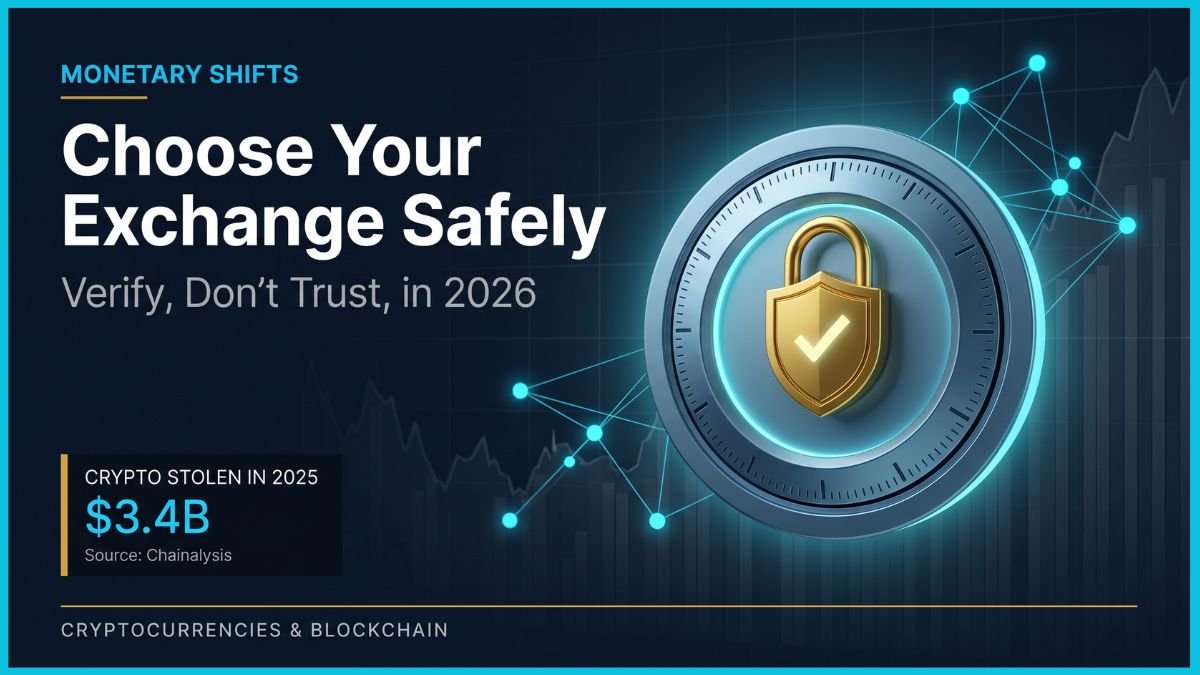
How to Choose a Crypto Exchange Safely in 2026

To choose a crypto exchange safely in 2026, prioritize platforms with regulatory licensing, audited proof of reserves, segregated customer funds, and a dedicated protection fund. Verify security history, withdrawal reliability, and fee transparency. The safest crypto exchange is one that lets you confirm—rather than trust—that your assets are fully backed one-to-one on-chain.

Introduction

Knowing how to choose a crypto exchange is no longer an optional skill—it is the single most consequential decision a new investor makes. The collapse of FTX in November 2022 erased an estimated $8.9 billion in customer funds and reframed the entire industry around one principle: verify, don’t trust. The lesson was reinforced in February 2025, when the Bybit breach drained roughly $1.5 billion in a single day, the largest digital-asset heist ever recorded. With total crypto theft reaching $3.4 billion across 2025 according to Chainalysis, the crypto exchange you select determines whether your capital is protected by audited reserves and regulatory oversight—or exposed to the same structural failures that destroyed FTX. This guide breaks down the security, regulatory, and operational criteria that separate institutional-grade exchanges from high-risk venues, so you can evaluate any platform against a consistent, evidence-based framework before you deposit a single dollar. read more

Continue Reading...
A premium cinematic editorial cover for Monetary Shifts featuring a sophisticated crypto hardware wallet. The device is glowing with an electric cyan checkmark, illustrating institutional-grade crypto wallet security and self-custody against a deep navy blue blockchain lattice background.

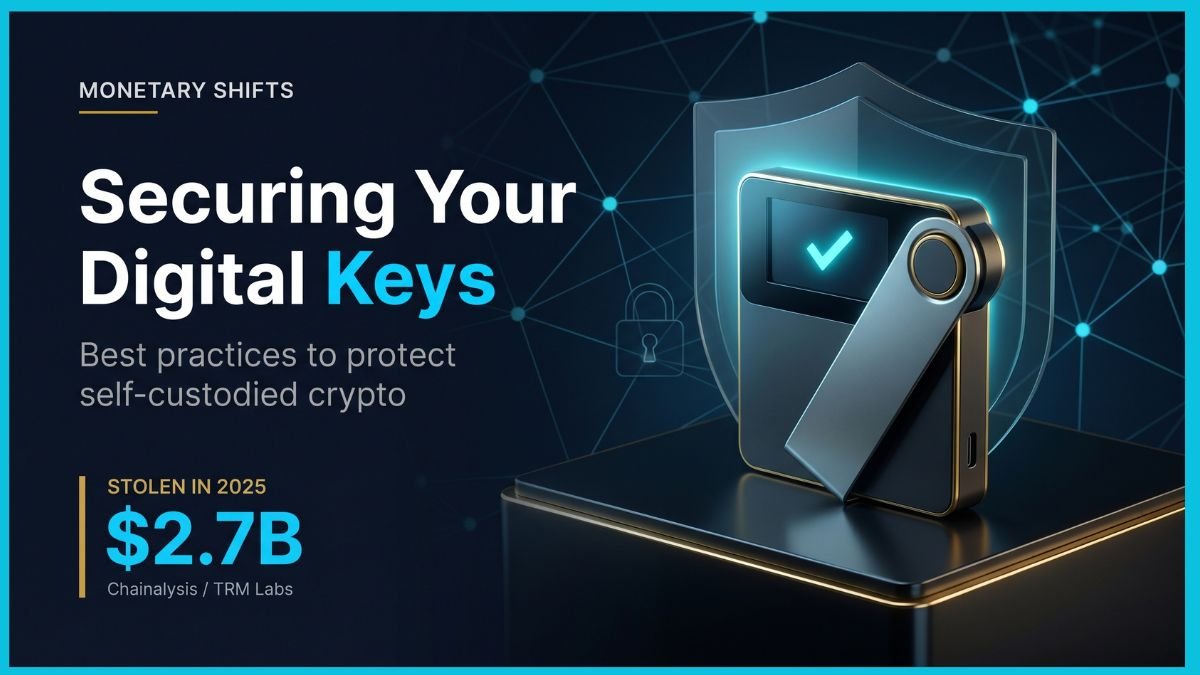
Crypto Wallet Security: Best Practices to Protect Your Coins

Crypto wallet security is the set of practices that keep the private keys controlling your digital assets out of an attacker’s reach. It works by storing keys offline, verifying every transaction on a trusted screen, and protecting your recovery phrase. It matters because, on most blockchains, a stolen key means an irreversible loss with no bank or insurer to reverse it.

Introduction

Self-custody puts you in charge of your own money, but it also makes you your own security department. In 2025, blockchain forensics firm Chainalysis tracked roughly $2.7 billion in stolen crypto, and personal wallet compromises surged to around 158,000 incidents affecting at least 80,000 individual victims. The threat is no longer aimed only at exchanges; ordinary holders are now squarely in the crosshairs. Strong crypto wallet security is what separates investors who keep their coins from those who learn the meaning of “not your keys, not your coins” the hard way. This crypto wallet security guide explains how wallets actually protect your assets, the practices institutional desks and serious self-custodians rely on, and the mistakes that drain wallets fastest. It sits within the broader story of how digital assets are reshaping custody, settlement, and ownership across the global financial system — and gives you a defensible playbook you can apply today. For readers still mapping the broader landscape, our guide to the cryptocurrency market for beginners places self-custody within the full market context. read more

Continue Reading...
A sophisticated editorial cover showing a classical financial building merging with a glowing cyan digital network and tokenized assets, illustrating the integration of blockchain technology in finance.

Blockchain Technology in Finance: How It Is Transforming Global Markets

Blockchain technology in finance is the use of distributed, cryptographically secured ledgers to record, settle, and automate financial transactions without relying solely on central intermediaries. It matters because it compresses settlement times, lowers costs, and adds transparency to a system built on trust. Its main impact: traditional finance and digital assets are converging into a single, programmable infrastructure.

The financial system is undergoing its most significant structural change since the move from paper certificates to electronic book-entry records. Understanding how blockchain reshapes money requires seeing it against the backdrop of the global financial system it is rebuilding. For decades, moving money and securities depended on layers of intermediaries, reconciliation, and multi-day settlement windows. Blockchain technology in finance challenges that architecture by offering a shared, tamper-evident record that updates in near real time. The shift is no longer theoretical. In 2026, blockchain and crypto are accelerating into mainstream finance through rising institutional adoption, clearer regulation, expanding tokenization, and maturing decentralized finance, according to industry analysis tracking the convergence of traditional and decentralized systems. read more

Continue Reading...
A premium editorial cover for Monetary Shifts featuring a luminous 3D blockchain network symbolizing DeFi and decentralized finance infrastructure, with institutional typography and a data card showing $119B Total Value Locked.

DeFi and Decentralized Finance: A Complete Guide for Investors

DeFi, or decentralized finance, is a system of financial services—lending, trading, borrowing, and earning yield—built on public blockchains and executed by smart contracts instead of banks. It matters because it removes intermediaries from finance, and its principal impact is open, programmable access to capital markets that now secure well over $100 billion in deposited assets globally.

Introduction

For most of modern history, access to credit, market-making, and yield was gated by licensed institutions: banks, brokers, clearinghouses, and exchanges. DeFi and decentralized finance challenge that arrangement by replacing the intermediary with code. On networks like Ethereum and Solana, a lending market, a derivatives venue, or a foreign-exchange desk can run as a set of audited smart contracts that anyone with a wallet can use, around the clock, without permission. read more

Continue Reading...
A premium editorial financial cover image featuring a glowing cyan data curve representing Bitcoin market cycles, peaking with a golden light burst next to a monolithic dark pillar embossed with a gold Bitcoin symbol.

Bitcoin Market Cycles Explained: From Halving to Hype

Bitcoin market cycles are the recurring, roughly four-year waves of accumulation, expansion, euphoria, and contraction that have shaped the asset since 2009. They matter because they convert a single supply rule — the halving — into a repeating pattern of capital flows, sentiment, and price discovery. Understanding them is the difference between reacting to noise and reading structure.

Introduction

Few patterns in modern finance are discussed as obsessively, or understood as poorly, as the Bitcoin market cycle. For more than a decade, the asset has appeared to move in a rhythm: a programmed supply cut known as the halving, followed by a long climb, a speculative blow-off, and a punishing drawdown — only for the sequence to begin again. Investors have treated this four-year clock almost as a law of nature. read more

Continue Reading...
A professional financial magazine cover titled

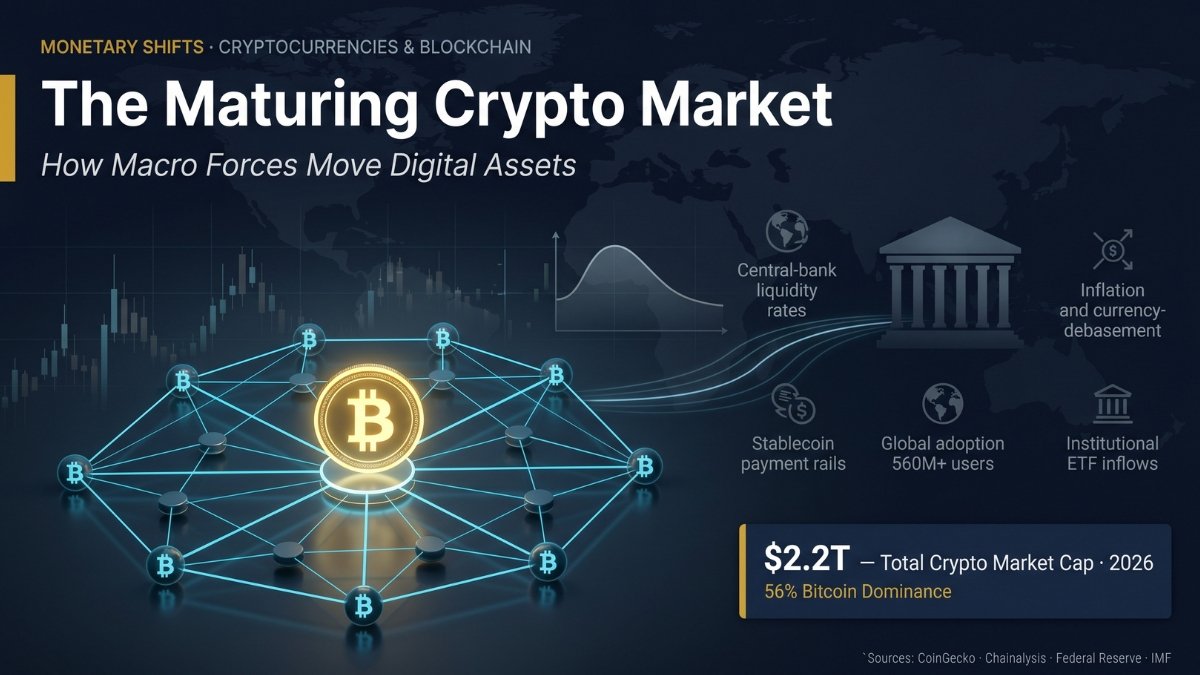
Cryptocurrency Market for Beginners: The Ultimate 2026 Guide

The cryptocurrency market is a global, 24/7 marketplace where digital assets like Bitcoin and Ethereum are issued, traded, and stored on blockchains rather than controlled by central banks. For beginners, it matters because it offers a new asset class with high returns, high volatility, and growing institutional adoption. As of mid-2026, the total crypto market is worth roughly $2.2 trillion.

Introduction

The cryptocurrency market for beginners can feel like stepping into a fast-moving financial frontier where fortunes are made and lost in hours, jargon piles up quickly, and headlines swing between euphoria and panic. Yet beneath the noise sits a maturing asset class that institutional investors, central banks, and regulators can no longer ignore — one that increasingly challenges the traditional financial system it was built to rival. After Bitcoin reached an all-time high of $126,272 in October 2025, the market entered a sharp correction, with total capitalization falling to around $2.4 trillion by the end of the first quarter of 2026, according to CoinGecko’s research team. By mid-2026 it hovered near $2.2 trillion, with Bitcoin commanding roughly 56% dominance. read more

Continue Reading...