
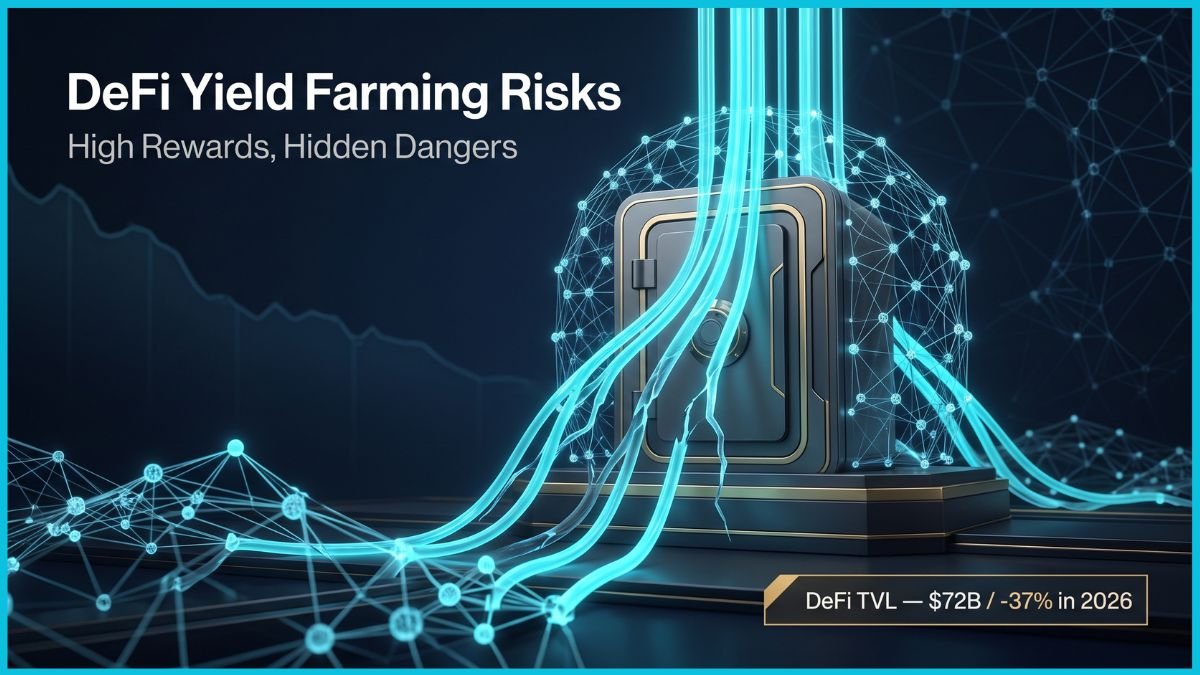
DeFi yield farming risks are the financial and technical dangers investors face when depositing crypto into decentralized protocols to earn yield. They include impermanent loss, smart contract exploits, token-price collapse, and liquidity traps. Understanding these risks matters because advertised returns rarely reflect the true probability of losing capital.
Few corners of decentralized finance attract attention as quickly as yield farming. The promise is simple and seductive: deposit idle crypto into a protocol, earn double-digit returns, and let compounding do the rest. Yet the gap between an advertised annual percentage yield and the money an investor actually keeps can be enormous. According to DefiLlama, total value locked across DeFi fell roughly 37% in the first half of 2026 to about $72 billion, a reminder that capital in these protocols is far from stable. Behind every attractive yield sits a layered structure of exposures that newcomers consistently underestimate. This guide examines the real DeFi yield farming risks, the mechanics that produce them, and the data investors should weigh before committing funds.
What Is DeFi Yield Farming?
DeFi yield farming is the practice of supplying cryptocurrency to decentralized protocols, such as lending markets or liquidity pools, in exchange for rewards. Those rewards arrive as trading fees, lending interest, or newly issued governance tokens. The strategy turns dormant assets into income-producing positions, but the returns scale directly with the risk taken on.
The mechanics rest on liquidity pools. When an investor deposits a pair of tokens, for example ETH and a stablecoin, into an automated market maker, those funds become tradable inventory. Traders swap against the pool and pay fees, and the liquidity provider earns a proportional share. Lending protocols work differently: deposited assets are borrowed by others who pay interest. In both cases, the participant becomes a counterparty to strangers and to code, not to a regulated institution.
Returns in 2026 have normalized sharply from the early “DeFi summer” era, when some pools advertised yields exceeding 1,000%. Conservative stablecoin strategies on established lending platforms now typically pay between 3% and 8%, while volatile asset pairs may offer 5% to 20% with materially higher danger. Anyone promising consistent returns above 20% is usually compensating depositors for hidden exposure rather than offering free money. That single insight separates durable strategies from the ones that quietly erode capital.
Impermanent Loss: The Most Misunderstood Risk
Impermanent loss is the most distinctive and least understood of all DeFi yield farming risks. It occurs when the price ratio of the two assets in a liquidity pool diverges after deposit. Because automated market makers rebalance the pool to maintain a target ratio, a liquidity provider can end up holding less value than if they had simply kept the tokens in a wallet.
A concrete example clarifies the mechanism. Suppose an investor deposits $10,000 into an ETH/USDC pool split evenly, with ETH at $2,000, contributing 2.5 ETH and 5,000 USDC. If ETH then climbs to $4,000, arbitrageurs trade against the pool until its internal price matches the market, leaving the provider with roughly 1.77 ETH and 7,071 USDC, worth about $14,142. Simply holding the original tokens would have produced $15,000. The roughly $858 shortfall is impermanent loss. The “impermanent” label misleads many newcomers: the loss only reverses if prices return to their starting ratio, which rarely happens.
The danger is far from theoretical. Research cited across the industry has found that a majority of liquidity providers on concentrated-liquidity venues like Uniswap V3 end up with net losses once impermanent loss is measured against collected fees. The clearest defense is asset selection. Stablecoin pairs such as USDC/USDT experience negligible impermanent loss because both tokens track roughly $1, yet still earn fee income. This is one reason serious investors study crypto wallet security and pool composition with equal care before committing capital.
Smart Contract Exploits and Protocol Failure
Every yield farming position depends on smart contracts, and that code is only as safe as its weakest line. Smart contract exploits remain among the most damaging DeFi yield farming risks because a single vulnerability can drain an entire pool in seconds, with no central authority to reverse the transaction. Audits and bug bounties reduce the probability of failure, but they never eliminate software risk.
The scale of the threat is documented. Chainalysis reported that crypto theft reached roughly $3.4 billion in 2025, the highest total since 2022, with the three largest incidents accounting for 69% of all losses. The standout was the $1.4 billion Bybit breach attributed to North Korea-linked actors, the largest crypto heist ever recorded. Notably, Chainalysis observed that DeFi-specific hack losses stayed suppressed even as locked capital recovered, which the firm attributed to stronger monitoring, faster incident response, and decisive on-chain governance, a meaningful shift from the early DeFi era when a successful exploit meant permanent loss.
That improvement does not make protocols safe. Independent trackers still counted well over $2 billion in DeFi-related exploits during 2025, and rug-adjacent events continue. The broader macroeconomic backdrop matters too, because periods of tight liquidity from central banks like the U.S. Federal Reserve tend to drain speculative capital and expose fragile, leverage-heavy protocols. The defensive principle is consistent: favor audited, battle-tested platforms with long operating histories over newer protocols offering outsized yields.
Token Collapse, Rug Pulls, and Liquidity Traps
Many farming rewards are paid in a protocol’s native governance token rather than in stablecoins or blue-chip assets. This creates a subtle but severe risk: an advertised APY can look spectacular while the reward token quietly loses value. If the token falls 90% during a market downturn, a position can post a negative real return even when the headline yield reads 50%. Numerous DeFi tokens have followed exactly this path.
Rug pulls represent the deliberate version of this danger. In a rug pull, anonymous developers attract deposits with extreme yields, then drain the liquidity and disappear. Warning signs are remarkably consistent: APYs above 1,000%, anonymous teams, unaudited contracts, and liquidity that founders can withdraw at will. The catastrophic 2022 collapse of the Terra ecosystem, where the Anchor protocol’s 20% yield drew billions before the system imploded and erased roughly $60 billion in value, remains the defining cautionary tale. Regulators including the U.S. Securities and Exchange Commission have since intensified scrutiny of yield-bearing crypto products.
Liquidity risk compounds the problem. Some farms impose lock-up periods during which deposits cannot be withdrawn, trapping capital precisely when an investor most wants to exit. Thinly traded pools can also become impossible to leave without severe slippage. The TVL data underscores the fragility: with DeFi locked value down sharply in 2026 and a large share of deposits effectively dormant, the difference between a liquid and an illiquid position can decide whether an investor recovers funds at all. Before committing, understanding broader cryptocurrency for beginners fundamentals provides essential context for evaluating any farm.
How to Manage DeFi Yield Farming Risks
Risk in yield farming cannot be eliminated, but it can be measured and reduced through discipline. The starting point is distinguishing the advertised APY from net yield. Gas fees, slippage, protocol fees, performance fees, and impermanent loss all subtract from displayed returns, and a 200% launch APY frequently collapses within weeks as incentives expire.
Diversification across protocols and asset types limits the damage from any single failure. Conservative participants often concentrate on stablecoin lending or low-volatility pairs, accept single-digit returns, and prioritize protocols with deep liquidity, transparent audits, and durable revenue from real fees rather than token emissions. Tools like DefiLlama’s yield tracker let investors compare live rates and verify whether a protocol’s TVL and revenue support its advertised payouts. Starting with small positions to learn a protocol’s mechanics before scaling up is a consistent feature of experienced behavior. These same principles of capital protection connect directly to how investors approach broader blockchain technology in finance and the institutionalization reshaping digital assets.
People Also Ask
Is DeFi yield farming profitable in 2026? It can be, but returns have normalized. Conservative stablecoin strategies typically yield 3% to 8% annually, while volatile pairs may reach 5% to 20% with significantly higher risk. Profitability depends on net yield after fees, slippage, and impermanent loss, not the advertised APY. Sustainable gains come from audited protocols earning real fees, not from chasing temporary triple-digit incentives.
What is the biggest risk in yield farming? Smart contract exploits cause the largest single-event losses, since a code vulnerability can drain a pool instantly with no recourse. For everyday liquidity providers, however, impermanent loss is the most common erosion of returns, and reward-token collapse frequently turns a high advertised APY into a negative real outcome.
How does impermanent loss work? Impermanent loss occurs when the price ratio of two pooled assets changes after deposit. The automated market maker rebalances the pool, leaving the provider with less of the appreciating asset. The loss becomes permanent on withdrawal unless prices return to their original ratio, which seldom happens in practice.
Are stablecoin pools safer for yield farming? Stablecoin pairs such as USDC/USDT carry almost no impermanent loss because both assets track roughly $1. They still earn trading fees and lending interest, typically 3% to 8% APY. However, they remain exposed to smart contract risk and rare depeg events, so audits and protocol selection still matter.
What is a rug pull in DeFi? A rug pull is a fraud where developers attract deposits with extreme yields, then drain the liquidity and vanish. Warning signs include APYs above 1,000%, anonymous teams, unaudited contracts, and liquidity that founders can withdraw freely. Established, audited protocols with long track records sharply reduce this exposure.
Conclusion
DeFi yield farming offers real opportunities, but the advertised APY is the beginning of the analysis, not the conclusion. The genuine DeFi yield farming risks, impermanent loss, smart contract exploits, token collapse, and liquidity traps, each demand a different defense, and ignoring any one of them can erase returns built over months. The investors who endure treat risk as part of the product rather than a footnote, favoring audited protocols, stable pairs, and diversified positions over the highest number on the screen. Before deploying capital, study the protocol, verify its data, and never commit more than you can afford to lose.
Frequently Asked Questions
Why are DeFi hack losses falling while attacks rise elsewhere? Chainalysis found that DeFi-specific exploit losses stayed suppressed in 2024 and 2025 even as locked capital recovered, a clear divergence from historical patterns. The firm credits proactive monitoring, rapid incident response, and decisive governance that can freeze or reverse stolen funds. Attackers have responded by shifting focus toward centralized services and personal wallets, which accounted for a growing share of total theft.
How much can you realistically earn yield farming? Realistic 2026 returns range from 3% to 8% APY on conservative stablecoin strategies and roughly 5% to 20% on volatile pairs, before fees and impermanent loss. Liquid staking pays around 3% to 4.5%. Net yield is always lower than the displayed figure once gas, slippage, and protocol fees are deducted, and returns above 20% almost always signal elevated risk.
Do I need a lot of money to start yield farming? No, some protocols allow deposits as small as $100. However, gas fees on Ethereum can consume returns on small positions, which is why many participants use lower-cost networks. Starting small to learn a protocol’s mechanics before scaling up is widely regarded as prudent practice, regardless of account size.
What is the difference between APR and APY in yield farming? APR represents simple interest without compounding, while APY includes the effect of compounding reinvested rewards. A 100% APR compounded daily equals roughly 171% APY, so the two figures can differ substantially. Always confirm which metric a protocol advertises, because the higher APY number can overstate expected returns if rewards are not actually reinvested.
How do I evaluate whether a DeFi protocol is safe? Check for completed third-party audits, a long operating history, transparent and non-anonymous teams, and revenue derived from real fees rather than token emissions. Verify the protocol’s TVL and yield claims against independent aggregators. Be skeptical of unusually high APYs, locked liquidity controlled by developers, and pools with thin trading volume that would be difficult to exit.
Important Notice: This article is provided for educational and informational purposes only and does not constitute financial, investment, legal, or tax advice. Cryptocurrency and DeFi investments carry significant risk, including the total loss of capital. Past performance does not indicate future results. Always conduct your own research and consult a qualified financial professional before making any investment decision.

About Financial Cryptarch
Financial Cryptarch is the Founder of Criptocurrencie and a finance professional with over 15 years of experience in Accounting and Corporate Finance. Holding a Bachelor’s Degree in Accounting and an MBA in Corporate Finance, he focuses on cryptocurrencies, macroeconomics, global finance, and international geopolitics, helping readers understand the forces shaping money, markets, and economic power.


