
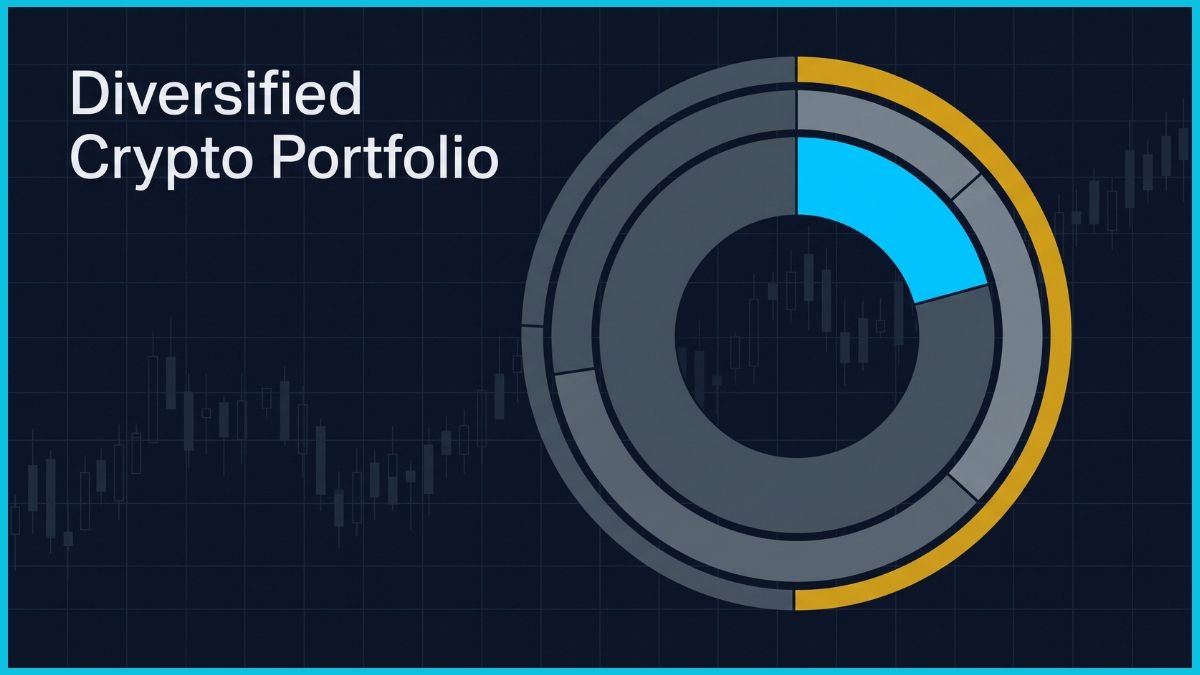
A diversified crypto portfolio spreads capital across assets with different risk profiles—a Bitcoin and Ethereum core, large-cap altcoins, and a stablecoin buffer—to reduce volatility and improve risk-adjusted returns. It works because no single position can sink the whole book, and disciplined allocation, not market timing, drives long-term results.
Building a diversified crypto portfolio is the difference between surviving a full market cycle and getting wiped out in a single drawdown. In mid-2026, the total crypto market capitalization sits near $2.15 trillion with Bitcoin dominance around 55.8%, according to data from CoinGecko. That backdrop—a Bitcoin-led market with elevated dominance—rewards structure over speculation. This guide walks through a practical, step-by-step framework drawn from institutional research, showing how to size your core, layer in growth and high-risk satellites, hold a stablecoin reserve, and rebalance with discipline. The goal is a portfolio that compounds across regimes rather than one that chases the day’s hottest token.
What Is a Diversified Crypto Portfolio?
A diversified crypto portfolio is a structured allocation that distributes capital across assets behaving differently across market conditions—typically a large core of Bitcoin and Ethereum, a satellite layer of altcoins, and a stablecoin reserve. The aim is not to maximize a single bet but to manage downside risk while capturing meaningful upside.
The critical insight is that diversification in crypto is about behavior, not quantity. Holding fifty tokens that all rise and fall together is not diversification—it is concentration in disguise. Most crypto assets share the same macro drivers: liquidity, sentiment, and Bitcoin’s dominance, which means correlations spike toward one during sharp drawdowns. Effective design therefore requires assets that each contribute a distinct role: Bitcoin for foundational store-of-value exposure, Ethereum for programmable-blockchain growth, altcoins for asymmetric upside, and stablecoins for liquidity and dry powder.
Step 1: Define Your Risk Profile and Position Size
Before choosing any asset, decide how much crypto belongs in your overall wealth. This is the single most consequential decision in the process. A widely cited conservative rule limits crypto to 5–10% of a total investment portfolio, with a ceiling near 20% for aggressive investors. The reason is volatility: even a modest 6% crypto allocation can nearly double a traditional portfolio’s overall volatility, a finding attributed to Morgan Stanley’s Global Investment Committee.
Your risk profile then shapes the internal split. A conservative investor anchors more heavily in Bitcoin and stablecoins; an aggressive investor accepts wider altcoin exposure. Be honest about your time horizon and tolerance for a 50–80% paper loss, because crypto delivers those routinely. If you are still learning the fundamentals, a primer on cryptocurrency for beginners is worth reviewing before sizing your first position. Unmanaged Bitcoin alone has carried annualized volatility above 65%, and altcoins amplify that figure considerably.
Step 2: Build the Core With Bitcoin and Ethereum
The core is the foundation that determines whether your portfolio survives stress. Institutional allocators consistently anchor crypto holdings in Bitcoin and Ethereum because of their depth of liquidity, market capitalization, and infrastructure maturity. Family offices typically hold 60–80% of their crypto allocation in Bitcoin, while corporate treasuries skew even more conservative at 80–90%.
Bitcoin functions as the base layer—the deepest liquidity, the longest track record, and the asset capital flows toward during market stress. Its supply is capped at 21 million coins on a fully programmatic schedule; Grayscale noted the 20 millionth coin was expected to be mined in March 2026, underscoring the scarcity narrative that anchors the “digital gold” thesis. Ethereum provides the growth component through its smart-contract platform, DeFi exposure, and staking yield, typically running 3–5% annually. Conservative institutions allocate roughly 15% to Ethereum, moderate ones 20%, and aggressive ones 25%.
A defensible starting point for most investors is a 60–70% core split between Bitcoin and Ethereum, weighted toward Bitcoin. With dominance elevated above the 50% threshold that historically separates Bitcoin-led markets from altcoin seasons, a core-heavy structure is the prudent default. Understanding why Bitcoin market cycles behave the way they do helps you size this core with conviction rather than emotion.
Step 3: Add a Satellite Layer of Altcoins
Satellites are where you reach for upside, and where most portfolios self-destruct. The discipline that separates winners is bounded position sizing. A common framework allocates 20–30% to large-cap altcoins with proven ecosystems and use cases—names that have survived multiple cycles—rather than rotating chaotically through whatever is trending.
Split the satellite layer by conviction. A growth tier holds established high-beta majors with real adoption; a high-risk tier holds newer tokens, DeFi protocols, and speculative plays. The non-negotiable rule: cap any single high-risk position at 1–2% of total crypto holdings, so that a token going to zero is a manageable setback rather than a portfolio-defining event. Before committing capital to any DeFi token, it pays to understand the mechanics of decentralized finance and how protocol risk differs from holding spot assets. Sector data helps here—total DeFi value locked stood near $71.8 billion in mid-June 2026 per DefiLlama, down sharply on the year, a reminder that satellite sectors can contract violently.
Step 4: Hold a Stablecoin Reserve
Stablecoins are the most underrated component of a well-structured allocation. They serve two functions: a liquidity buffer that lets you act during drawdowns, and dry powder for systematic accumulation. A practical baseline holds 10–20% in stablecoins, increasing by 5–10 percentage points during fear-driven markets when accumulation opportunities are richest.
The stablecoin market itself has matured into financial infrastructure, with circulating supply crossing $314 billion in mid-2026 according to sector data, and USD-denominated coins accounting for roughly 99% of supply. Regulatory clarity from the GENIUS Act in the United States and MiCA in Europe has accelerated institutional comfort. Reserve transparency matters: issuers like Circle publish periodic attestations of the assets backing USDC. Holding a reserve is not sitting on the sidelines—it is keeping ammunition for when structure-driven investors do their best buying.
Step 5: Rebalance With Discipline
A portfolio drifts. A strong altcoin run can balloon a 2% satellite into 8% of your book, quietly turning a diversified portfolio into a concentrated bet. Rebalancing restores your target weights and enforces the discipline of selling strength and buying weakness.
Monthly rebalancing is the sweet spot for most long-term investors, supplemented by threshold triggers: act when any asset drifts more than ±15–20% from its target weight. Avoid rebalancing more than twice a month—transaction fees and taxable events compound into a material drag that offsets the benefit. Where possible, rebalance using new cash inflows toward underweight positions rather than selling appreciated assets, which sidesteps capital-gains friction. Markets reward systematic investors and punish reactive ones; a written rebalancing rule removes emotion from the moment it matters most.
Sample Diversified Crypto Portfolio Allocations
The table below illustrates how the same framework adapts across risk profiles. Treat these as starting templates, not prescriptions—your numbers should reflect your horizon and tolerance.
| Allocation Sleeve | Conservative | Balanced | Aggressive |
|---|---|---|---|
| Bitcoin (core) | 55% | 45% | 35% |
| Ethereum (core) | 15% | 20% | 20% |
| Large-cap altcoins | 5% | 15% | 25% |
| High-risk satellites | 0% | 5% | 10% |
| Stablecoin reserve | 25% | 15% | 10% |
A conservative book leans on Bitcoin and a large cash buffer; an aggressive book accepts wider altcoin beta with strict per-position caps. Across every profile, the core remains the majority of the portfolio—because a structure that survives the downturn is what lets you participate in the recovery.
How Many Coins Should a Diversified Crypto Portfolio Hold?
A well-diversified book usually holds between five and ten assets, not dozens. The objective is exposure to different behaviors—store of value, smart-contract growth, high-beta upside, and stable liquidity—rather than a long list of correlated tokens. Beyond roughly ten positions, additional coins typically add tracking complexity and correlation without meaningful diversification benefit.
People Also Ask
What percentage of my portfolio should be in crypto? Most conservative frameworks limit crypto to 5–10% of total investable assets, with aggressive investors capping near 20%. Because even a 6% allocation can sharply raise overall portfolio volatility, position size should reflect your tolerance for large drawdowns and never exceed what you can afford to lose entirely.
Is Bitcoin or Ethereum a better core holding? Both serve distinct roles. Bitcoin offers deeper liquidity, lower relative volatility, and store-of-value characteristics that attract capital during stress. Ethereum provides growth through its smart-contract ecosystem and staking yield but carries higher volatility. Most diversified portfolios hold both, weighting Bitcoin more heavily in the core.
How often should I rebalance a crypto portfolio? Monthly rebalancing suits most long-term investors, paired with threshold triggers when any asset drifts ±15–20% from target. Rebalancing more than twice monthly tends to erode returns through fees and taxable events, while rebalancing too rarely allows concentration to creep back into the portfolio.
Do stablecoins count as diversification? Yes. Stablecoins reduce overall portfolio volatility and provide liquidity to buy during drawdowns. They function as dry powder rather than a growth asset, and a 10–20% reserve gives a portfolio both stability and the optionality to accumulate when prices fall.
Conclusion
Building a diversified crypto portfolio is a process, not a single trade: define your risk profile and position size, anchor a Bitcoin-and-Ethereum core, add bounded altcoin satellites, hold a stablecoin reserve, and rebalance on a schedule. The throughline is discipline—structure consistently beats timing across full market cycles. Start by writing down your target allocation and your rebalancing rule before you deploy a single dollar. With a framework in place, you can navigate volatility as a systematic investor rather than react to it as an emotional one.
FAQ
What is the safest way to build a diversified crypto portfolio? The safest approach starts with conservative position sizing—limiting crypto to a small share of total wealth—then anchoring the majority of that allocation in Bitcoin and Ethereum. Add a meaningful stablecoin reserve for liquidity, keep altcoin satellites small and bounded, and rebalance on a fixed schedule. Safety in crypto comes less from picking winners than from controlling downside: capping per-position risk, avoiding leverage, and never investing money you cannot afford to lose. A written plan that survives a 50–80% drawdown without forcing panic decisions is the foundation of durable, long-term participation.
How much money do I need to start building a crypto portfolio? There is no hard minimum, because most exchanges allow fractional purchases of Bitcoin and Ethereum. What matters more than the starting amount is the framework: the same percentage allocations apply whether you begin with a few hundred dollars or a substantial sum. Many investors build positions gradually through dollar-cost averaging, deploying fixed amounts on a regular schedule to smooth out entry prices. Starting small while you learn the mechanics of custody, security, and rebalancing is prudent, then scaling the position as your confidence and understanding grow over time.
Should a diversified crypto portfolio include DeFi tokens? DeFi tokens can belong in the high-risk satellite layer, but they require extra caution. Protocol risk, smart-contract vulnerabilities, and sharp sector drawdowns make them more volatile than holding spot Bitcoin or Ethereum. Total value locked in DeFi contracted significantly through 2026, illustrating how quickly the sector can shrink. If you include DeFi exposure, keep individual positions capped at 1–2% of holdings, prioritize established protocols with audited contracts and real usage, and treat the allocation as speculative capital rather than core savings.
How do I protect my crypto holdings from theft? Security is inseparable from diversification—an uninsured loss erases allocation discipline instantly. Use hardware wallets for long-term holdings, enable two-factor authentication on every account, and never share recovery phrases. Following established crypto wallet security practices reduces single-point-of-failure risk. For larger holdings, cold storage that keeps private keys offline meaningfully shrinks the attack surface. Treat custody as a core part of your portfolio strategy rather than an afterthought, because the strongest allocation framework is worthless if the underlying assets are compromised.
Important Notice: This article is for educational and informational purposes only and does not constitute financial, investment, tax, or legal advice. Cryptocurrency markets are highly volatile and carry substantial risk of loss. Past performance does not guarantee future results. Always conduct your own research and consult a qualified, licensed financial professional before making investment decisions. Never invest more than you can afford to lose.

About Financial Cryptarch
Financial Cryptarch is the Founder of Criptocurrencie and a finance professional with over 15 years of experience in Accounting and Corporate Finance. Holding a Bachelor’s Degree in Accounting and an MBA in Corporate Finance, he focuses on cryptocurrencies, macroeconomics, global finance, and international geopolitics, helping readers understand the forces shaping money, markets, and economic power.


