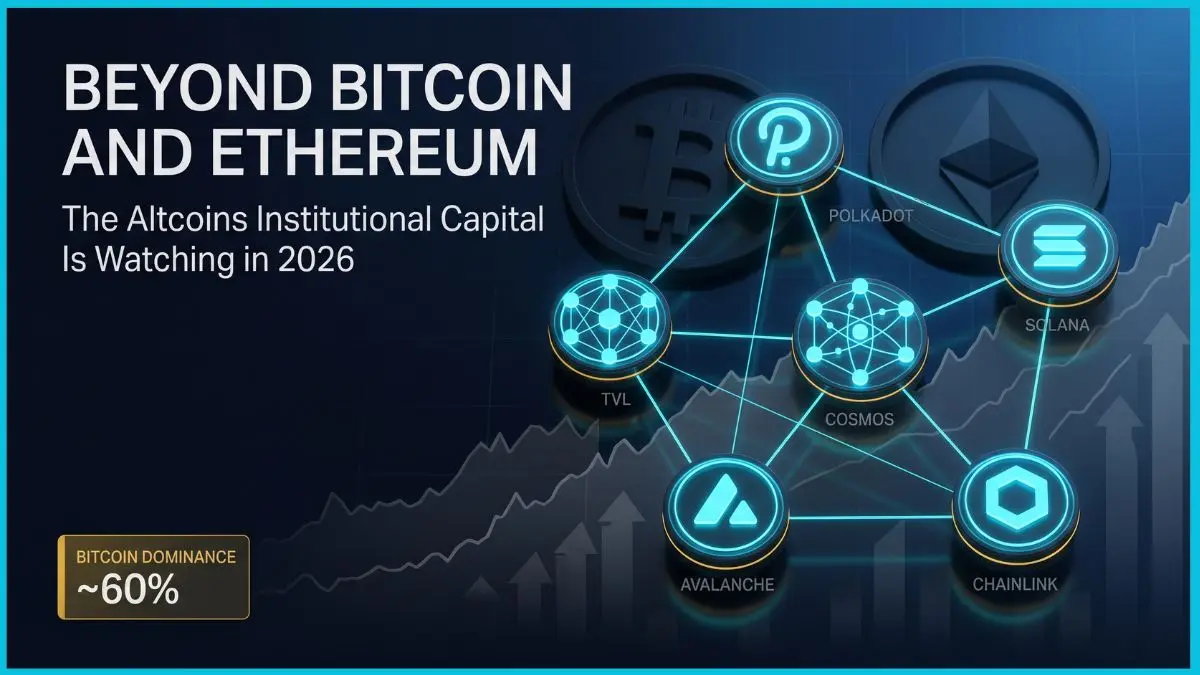
The altcoins to watch in 2026 are no longer judged by hype or speed alone. With Bitcoin trading as a macro asset and Ethereum cementing its role as institutional settlement infrastructure, capital is rotating selectively into a small group of alternative cryptocurrencies that can prove real on-chain revenue, regulated access, or enterprise integration. This guide explains which projects matter, why, and how to evaluate them without chasing a buy list.
What Are the Top Altcoins to Watch in 2026?
The leading altcoins to watch in 2026 are Solana, XRP, Chainlink, Avalanche, and Cardano. Each represents a distinct thesis: high-throughput application chains, regulated cross-border payments, real-world-asset oracle infrastructure, configurable enterprise networks, and compliance-focused settlement. They matter because institutional ETF access and verifiable on-chain activity now drive demand rather than speculation.
Introduction
For most of crypto’s history, “altcoins to watch” meant whatever token promised the largest near-term multiple. That logic broke in 2026. The distinction between Bitcoin and the rest of the market has widened sharply: Bitcoin increasingly trades as a macro asset shaped by monetary policy and institutional flows, while altcoins are evaluated on network usage, fee revenue, and enterprise adoption. With Bitcoin dominance hovering around 59–60% and the Altcoin Season Index reading in the middle of its range, broad altcoin exposure has underperformed — only assets with active institutional mandates or auditable on-chain revenue are leading what analysts call a selective rotation — a pattern that only makes sense in the context of Bitcoin market cycles, which set the tempo for every altseason. This article looks beyond Bitcoin and Ethereum to the altcoins whose fundamentals justify attention, connecting each to the broader shift of global finance onto programmable rails. Expect a framework you can reuse, not a promise of returns.
What Are Altcoins, and Why Do They Matter in 2026?
Altcoins are all cryptocurrencies other than Bitcoin. They range from smart-contract platforms and payment-focused tokens to oracle networks and meme assets whose value is primarily social. In 2026, the altcoins to watch have matured into clearly separated risk tiers, scored on realized performance, the durability of the thesis behind that performance, and the most likely failure mode.
The macro backdrop reframes why these assets matter. As major banks integrate blockchain into their operations, trillions of dollars in transactions and managed assets could migrate on-chain. The tokenization of real-world assets illustrates the scale: the total on-chain market value of tokenized real-world assets has surpassed $28 billion, with more than 170 distinct asset issuers now active. This is the institutional adoption story that ties any serious altcoin analysis to macroeconomics and monetary policy — the same forces that govern how the Federal Reserve manages global liquidity. Understanding how this connects to the broader system starts with the foundational shift covered in blockchain technology in finance.
Solana (SOL): The High-Beta Execution Chain
Among the altcoins to watch in 2026, Solana has emerged as Ethereum’s closest competitor and the tier’s high-beta growth bet. Its architecture — a single global state machine, parallel transaction execution, and proof-of-history ordering — is built for consumer-facing applications that demand scale and low fees.
The fundamentals are the strongest argument. As of mid-January 2026, Solana ranked first among all Layer-1 chains by transaction volume, processing 515 million transactions with 27.1 million active addresses. Trailing-twelve-month ecosystem revenue sits near $2.85 billion, and Solana hosts the largest non-Ethereum decentralized finance ecosystem, with lending markets, perpetuals venues, and liquid-staking protocols. Institutional capital has followed: spot Solana ETFs surpassed $1 billion in assets under management, creating a structural demand floor that did not exist in prior cycles. The token traded roughly $85–$94 through much of 2026, up about 180% year-to-date.
The bear case is equally concrete. Solana’s outage history — six full-network halts between 2022 and 2024 — high validator hardware requirements, and stake concentration among large operators remain unresolved risks. The 2026 protocol upgrades, including Alpenglow and the Firedancer validator engine, are designed to address reliability and throughput, but they must deliver measurable results to justify further multiple expansion.
XRP: The Regulatory-Catalyst Trade
XRP enters 2026 in a fundamentally different position from any other large-cap altcoin. The August 2025 resolution of Ripple’s multi-year SEC enforcement case removed the regulatory overhang that had suppressed institutional demand for years. Spot XRP ETF products launched and accumulated $1.37 billion in inflows within their first 60 days — a discrete, structurally significant catalyst.
The result was the strongest 2026 print in the cohort: XRP delivered over +400% year-to-date as of May 2026. Its core value proposition remains efficient cross-border settlement, with the XRP Ledger supporting roughly 1,500 transactions per second and three-to-five-second finality. According to the U.S. Securities and Exchange Commission, the approval of spot crypto products has broadened regulated institutional access across the asset class.
The defining risk is that the regulatory wins represent the peak of positive catalysts rather than the start of a new growth phase. XRP’s thesis rests on legal certainty and inflow events rather than smart-contract or DeFi demand, and Ripple has announced institutional partnerships for years without consistently demonstrating organic transaction volume. ETF-driven demand can also prove fickle if returns lag peers.
Chainlink (LINK): The Infrastructure Layer for Tokenized Finance
If Solana and XRP are bets on specific ecosystems, Chainlink is a bet on the plumbing connecting all of them to traditional finance. As an oracle network, it links smart contracts to external real-world data, and in 2026 it has become the dominant infrastructure for real-world-asset tokenization.
The numbers describe a near-utility position. Chainlink secures roughly $33.1 billion in total value across more than 500 protocols, holding the large majority of the oracle market, while its cross-chain interoperability protocol processed over $18 billion in transfer volume in the first quarter of 2026 — up 319% year-over-year. Its institutional roster is the real signal: it works with major financial-market infrastructures including Swift, Euroclear, and Kinexys by J.P. Morgan. The infrastructure thesis extends to how value moves between networks, a problem explored in crypto exchange safety when assets cross venues.
Chainlink’s role in connecting blockchains to bank systems makes it inseparable from the institutional adoption discussed across the wider decentralized finance ecosystem. The risk is value capture: securing trillions in transaction value does not automatically translate into token demand, and LINK has historically traded far below its cycle peak.
Avalanche (AVAX) and Cardano (ADA): Differentiated Bets
Beyond the leaders sit two of the altcoins to watch in 2026 with credible but unproven theses. Avalanche uses a primary network plus configurable subnets — rebranded as custom Layer-1s — that give projects their own validators, fee tokens, and virtual-machine choices. Subnet adoption from gaming and institutional projects keeps the network technically active, and Avalanche appears within Chainlink’s multi-chain real-world-asset rollout. Its challenge is demonstrating durable fee share against Ethereum Layer-2s and Solana.
Cardano remains the cohort’s most debated name. Its research-first, peer-reviewed proof-of-stake design and governance depth appeal to investors who favor caution, and the network supports native USDC. But it carries the weakest DeFi-liquidity case among the leaders, and some analysts have questioned its staying power given comparatively low developer and user activity. Cardano’s 2026 upgrades aim to improve scalability and utility, which would need to translate into measurable on-chain demand to change the narrative. On-chain data such as total value locked, transaction counts, and developer commits is published transparently through aggregators like DefiLlama, which lets investors verify whether a chain has real economic activity.
How to Evaluate Any Altcoin: A Reusable Framework
The most useful skill is not memorizing this year’s list but learning to assess the altcoins to watch in 2026 — and any future candidate — on five axes. First, value capture: does network usage translate into token demand? Second, usage: real transactions and fee revenue, not throughput marketing. Third, tokenomics — unlock schedules, team allocations, and supply caps move price more than narrative. Fourth, regulatory exposure, which shifted repeatedly across 2025 and 2026. Fifth, distribution: how concentrated is ownership. Independent research from firms such as Galaxy Research and on-chain analytics platforms help validate these signals before any position graduates from a watch-list to a sized allocation.
This framework matters because performance and market cap measure different things. The largest assets by market value are not automatically the most attractive, and the strongest recent performers often carry the least settled fundamentals.
People Also Ask
Which altcoin has the best fundamentals in 2026?
Solana carries the strongest cited on-chain fundamentals among major altcoins in 2026, including leading Layer-1 transaction volume and roughly $2.85 billion in trailing-twelve-month ecosystem revenue. However, “best fundamentals” depends on the metric: Chainlink leads on institutional integration, while XRP leads on regulatory clarity. Each serves a different investor mandate.
Why is XRP up so much in 2026?
XRP’s outsized 2026 performance stems from a specific catalyst: the August 2025 resolution of Ripple’s SEC enforcement case removed a long-standing regulatory overhang. Spot XRP ETFs subsequently launched and drew $1.37 billion in inflows within 60 days, channeling institutional capital into the asset. Analysts view this as a structurally unrepeatable event rather than recurring demand.
Is Cardano still worth watching in 2026?
Cardano remains relevant for its governance depth, peer-reviewed development, and cautious design, but it faces serious criticism over low developer activity and a thin DeFi ecosystem. Some analysts question whether it can retain a top ranking. Investors should watch on-chain metrics like total value locked and active addresses to judge whether its 2026 upgrades produce real adoption.
What is the difference between top altcoins by market cap and by performance?
Market cap measures current circulating value, while performance measures recent returns. A token can rank high by market cap because of a large supply yet deliver weak returns, and vice versa. The strongest year-to-date performers often have the least settled fundamentals, so the two lists frequently look very different.
Do altcoins outperform Bitcoin in 2026?
Broadly, no. With Bitcoin dominance near 59–60%, most altcoins have underperformed Bitcoin in 2026. Only a narrow set of assets with active institutional ETF mandates or auditable on-chain revenue — chiefly XRP, Solana, and Ethereum — have led a selective rotation, while the wider altcoin market has lagged.
Conclusion
The altcoins to watch in 2026 reward discipline over speculation. Solana, XRP, Chainlink, Avalanche, and Cardano each represent a distinct thesis, and the common thread is that institutional access and verifiable on-chain activity now decide which projects sustain demand. The key takeaway is simple: evaluate value capture, usage, tokenomics, regulation, and distribution before treating any token as more than a watch-list candidate. As a next step, track the on-chain metrics and ETF flows behind each name, and connect every position to the broader migration of global finance onto blockchain rails.
FAQ
What does “beyond Bitcoin and Ethereum” actually mean for investors?
It means broadening analysis to alternative cryptocurrencies that solve problems the two largest assets do not address directly. Bitcoin functions primarily as a macro store of value and Ethereum as the dominant smart-contract settlement layer. Altcoins like Solana, XRP, Chainlink, Avalanche, and Cardano target specific niches — high-speed applications, cross-border payments, data oracles, configurable enterprise chains, and compliance-focused settlement. For investors, “beyond Bitcoin and Ethereum” is not a call to abandon the majors but to understand where differentiated exposure might add value, always weighed against materially higher volatility and execution risk.
How important are spot ETFs to altcoin demand in 2026?
Spot ETFs have become one of the most important structural demand sources in 2026. They create a regulated channel for institutional capital that did not exist in prior cycles, establishing what analysts call a demand floor. Spot Solana ETFs surpassed $1 billion in assets, and spot XRP products drew over a billion dollars in their first weeks. That said, ETF-driven demand can be fickle: if a token’s returns lag peers, regulated flows can reverse. ETFs amplify existing theses rather than replace the need for genuine network usage.
What on-chain metrics should I track for altcoins?
The most informative metrics are total value locked, daily active addresses, transaction counts, fee revenue, and developer activity. Total value locked shows capital committed to a network’s applications; active addresses and transaction counts indicate real usage; fee revenue distinguishes durable economic activity from incentive-driven throughput; and developer commits signal whether builders are still shipping. Aggregators publish much of this data transparently. Watching these figures over time reveals whether a chain has staying power or is gradually bleeding activity despite a large market capitalization.
Are meme coins considered altcoins to watch in 2026?
Technically, meme coins are altcoins, and some maintain large market capitalizations driven by social value and liquidity. However, within a framework focused on value capture, usage, and durable fundamentals, meme assets sit at the speculative extreme. They can influence market narratives because of their liquidity, but they lack the on-chain revenue or institutional integration that define the selective rotation of 2026. Investors should treat them as high-volatility, sentiment-driven positions rather than fundamentals-based allocations, sizing any exposure accordingly.
How does macroeconomics affect altcoin prices?
Macroeconomic conditions increasingly shape the entire crypto market. Monetary policy, liquidity cycles, and institutional capital flows now influence Bitcoin most directly, and altcoins inherit that backdrop while adding their own usage-based dynamics. When central-bank liquidity tightens, speculative altcoins typically suffer first; when conditions ease and institutions deploy capital, assets with credible fundamentals tend to benefit. Regulatory developments — from U.S. securities decisions to the EU’s framework — also move prices. This is why serious altcoin analysis connects token-level fundamentals to the broader monetary and macroeconomic environment.
Important Notice: This content is for educational and informational purposes only and does not constitute investment advice or financial, legal, or tax counsel. Crypto assets are high-risk and highly volatile; past performance does not guarantee future returns. Do your own research and consult a licensed professional before making any investment decisions.

About Financial Cryptarch
Financial Cryptarch is the Founder of Criptocurrencie and a finance professional with over 15 years of experience in Accounting and Corporate Finance. Holding a Bachelor’s Degree in Accounting and an MBA in Corporate Finance, he focuses on cryptocurrencies, macroeconomics, global finance, and international geopolitics, helping readers understand the forces shaping money, markets, and economic power.


