
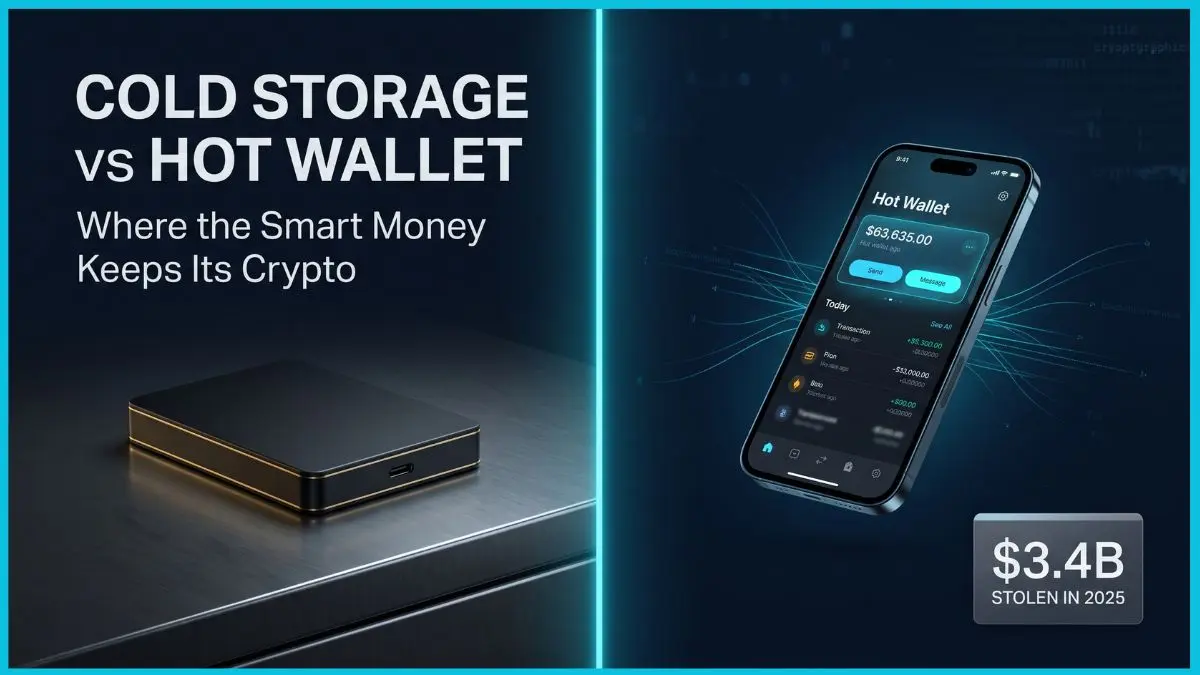
Cold storage vs hot wallet is the choice between keeping cryptocurrency offline on a hardware device or online in software connected to the internet. Cold storage prioritizes long-term security by isolating private keys from networks, while hot wallets prioritize speed and convenience for active trading. Most investors use both.
Few decisions shape an investor’s security posture more than the cold storage vs hot wallet question. As capital floods back into digital assets and tens of millions of new holders enter the market, the way private keys are stored has become the single largest determinant of whether funds survive. The stakes are not theoretical: Chainalysis recorded roughly $3.4 billion stolen across the cryptocurrency ecosystem in 2025, the highest annual figure since 2022, with personal wallet compromises reaching 158,000 incidents. Understanding this trade-off between offline and online custody is therefore foundational to any serious approach to self-custody. This guide breaks down how each method works, what the data reveals about real-world risk, and how institutional and retail holders are combining both to balance security against accessibility.
What Is Cold Storage?
Cold storage refers to keeping cryptocurrency private keys completely offline, disconnected from any internet-facing system. The keys live on a dedicated hardware device, an air-gapped computer, or even a paper backup, and they only touch a network momentarily when a transaction is signed and broadcast. Because the secret never leaves the device, remote attackers, malware, and phishing pages cannot reach it.
This isolation is the entire point. Hardware wallets store private keys in a tamper-resistant secure element and require physical confirmation for every outgoing transaction, which neutralizes the most common remote attack vectors. The principle behind self-custody is captured in the industry maxim “not your keys, not your coins” — if a third party controls the keys, the holder does not truly control the asset. For long-term holders, retirement-style positions, and institutional treasuries, cold storage has become the default standard. Regulators have reinforced this: Japan’s April 2025 revision to its Financial Services Agency exchange rules effectively requires exchanges to hold most customer funds offline, and the EU’s MiCA framework pushes licensed custodians toward segregated, auditable custody.
The market reflects the shift. The global hardware wallet market was valued at roughly $564.6 million in 2025 and is forecast to grow at a double-digit compound annual rate through the early 2030s, driven by exactly these security and regulatory pressures. Cold wallets, while still a minority of the segment, are growing faster than hot devices — a clear signal that the migration toward offline storage is accelerating after a string of high-profile exchange failures.
What Is a Hot Wallet?
A hot wallet is any cryptocurrency wallet that stays connected to the internet — a mobile app, a browser extension, a desktop client, or the custodial wallet built into an exchange account. Because it is always online, a hot wallet can send, receive, swap, and interact with decentralized applications in seconds, making it the natural home for funds that are actively traded or deployed.
That connectivity is also its weakness. Hot wallets remain the dominant storage method in practice — roughly 78% of crypto wallet users rely on them — precisely because they are convenient, but they expose private keys to the online environment where malware, phishing, and credential theft operate. The distinction between custodial and non-custodial hot wallets matters here. With a custodial hot wallet, an exchange holds the keys on the user’s behalf; with a non-custodial hot wallet, the user holds them but stores them on an internet-connected device. Both carry online risk, but the failure modes differ: custodial users inherit the exchange’s security, while non-custodial users inherit the security of their own device.
Hot wallets are best understood as a checking account rather than a vault. They are designed for the funds a holder needs to move, not the funds a holder needs to protect indefinitely. Active traders, DeFi participants, and NFT collectors lean on hot wallets for the real-time access their activity demands, accepting elevated risk in exchange for speed.
The Real Risk Data: What 2025 Revealed
The choice between cold and hot storage is ultimately settled by evidence, and 2025 produced an unusually clear picture. According to Chainalysis, the roughly $3.4 billion stolen in 2025 was heavily concentrated: the top three hacks accounted for 69% of all service losses, and a single incident — the $1.5 billion compromise of the Bybit exchange in February — represented nearly half the annual total. Crucially, that breach traced to a compromise of signing infrastructure on internet-connected systems, the structural vulnerability that cold storage is designed to remove.
The exchange and hot-wallet attack surface drove the largest losses. Centralized services accounted for 88% of stolen value in the first quarter of 2025, and forensic analysis of major exchange breaches repeatedly points to compromised hot-wallet signing flows rather than protocol bugs. In one widely studied incident at a major South Korean exchange, attackers drained roughly $33–35 million from a hot wallet through hundreds of transactions in a fifteen-minute window — a burst pattern impossible against truly offline storage.
For individuals, the trend was different but instructive. Personal wallet compromises surged to 158,000 incidents affecting at least 80,000 unique victims, even as the total value stolen from individuals fell to $713 million from $1.5 billion the prior year. Most of these losses traced to seed-phrase theft, device malware, and phishing — attacks that overwhelmingly target keys held on connected devices. The data published by the FBI’s IC3 reinforces the scale of the broader threat, with U.S. crypto-related fraud complaints reaching record highs in 2025. The lesson is consistent across every dataset: the more time keys spend online, the larger the attack surface.
How to Choose: Matching Storage to Purpose
The most useful reframing is that choosing between cold storage and a hot wallet is rarely an either/or decision. Surveys show retail users typically manage two to three wallets, deliberately splitting holdings across hot and cold environments by purpose. The right allocation depends on three variables: how much value is at stake, how frequently it needs to move, and how much operational complexity the holder can sustain.
A practical framework treats the question like personal banking. Funds reserved for long-term holding belong in cold storage, where the cost of slower access is irrelevant. Funds earmarked for trading, payments, or DeFi belong in a hot wallet sized to what the holder is willing to lose. This mirrors how disciplined investors approach a diversified crypto portfolio — segmenting assets not only by token but by custody risk. Strong crypto wallet security practices apply to both tiers, but the consequences of failure are far higher for the connected layer.
Several factors should weigh on the decision:
- Value at risk: Larger balances justify the friction and cost of hardware-based cold storage.
- Transaction frequency: Daily traders need hot-wallet speed; long-term holders do not.
- Technical comfort: Cold storage demands disciplined seed-phrase management and backup hygiene.
- Threat model: High-profile or high-net-worth holders face targeted attacks and benefit from multi-signature cold setups.
Best Practices for Securing Both
Whichever balance a holder strikes, certain practices are non-negotiable. For cold storage, the priorities are buying hardware from the manufacturer directly to avoid supply-chain tampering, recording the recovery seed phrase on durable offline media, and never entering that phrase into any internet-connected device or website. Verifying every transaction on the device screen — not just the host computer — defeats the address-swapping malware that has drained countless hot wallets.
For hot wallets, the goal is to minimize both the balance held and the attack surface. Multi-factor authentication materially reduces compromise risk; research cited across security reports shows wallets using MFA experience meaningfully lower rates of takeover. Holders should treat seed phrases as the crown jewels, remain skeptical of unsolicited links and “support” contacts, and segregate the device used for crypto from general browsing where possible. Institutions increasingly layer multi-signature governance on top of cold storage, requiring multiple independent approvals before any movement — a model that retail holders with significant balances can adopt through commercially available multisig services. As the broader story of blockchain in finance shows shows, custody discipline is what separates durable participants from cautionary tales.
What Is the Safest Way to Store Cryptocurrency?
For the vast majority of holders, the safest approach is a hardware cold-storage wallet for long-term holdings combined with a minimally funded hot wallet for active use. Cold storage keeps private keys offline and immune to remote attacks, while the hot wallet limits exposure to only the funds a holder can afford to lose. This tiered model consistently outperforms keeping everything in one place.
People Also Ask
Is cold storage safer than a hot wallet? Yes. Cold storage keeps private keys completely offline, removing them from the reach of remote attackers, malware, and phishing. Hot wallets stay connected to the internet, which is why exchange and personal-wallet compromises — responsible for the bulk of the $3.4 billion stolen in 2025 — overwhelmingly target online keys. For long-term holdings, cold storage is materially safer.
Can I lose my crypto with a hardware wallet? Yes, but usually through user error rather than remote hacking. The most common ways to lose funds from cold storage are losing the recovery seed phrase, recording it incorrectly, or being tricked into entering it on a fraudulent website. The hardware itself is highly resistant to remote attack, so the security burden shifts to disciplined backup and seed-phrase management.
Do I need a hardware wallet for small amounts of crypto? Not necessarily. For small balances actively used for trading or payments, a reputable non-custodial hot wallet with strong authentication is often sufficient. A hardware wallet becomes worthwhile once holdings represent meaningful value or are intended for long-term storage, where the offline protection justifies the cost and added friction.
What happens to my crypto if an exchange gets hacked? If funds are held in a custodial hot wallet on a hacked exchange, recovery depends entirely on the exchange’s reserves and policies. Some platforms absorb losses from corporate treasuries, but there is no guarantee. Holding assets in personal cold storage removes this counterparty risk, since the funds never sit on the exchange’s infrastructure.
Are mobile wallets considered hot or cold? Mobile wallets are hot wallets because they run on internet-connected smartphones. Some pair with hardware devices or NFC cards to add a cold-storage layer, but a standard mobile app stores keys on a connected device and carries the same online exposure as any other hot wallet.
Conclusion
The cold storage vs hot wallet decision comes down to matching each method to its purpose: cold storage for the funds you intend to protect, hot wallets for the funds you intend to use. The 2025 data makes the underlying principle unmistakable — the more time private keys spend online, the larger the attack surface, and the concentration of losses in connected systems is no coincidence. Rather than choosing one approach, the strongest holders combine both, sizing each tier to its risk. The practical next step is to audit your own holdings, move long-term positions into cold storage, and keep only working capital in a hot wallet.
Important Notice: This content is for educational and informational purposes only and does not constitute financial, investment, legal, or tax advice. Crypto assets are volatile and high-risk. Do your own research and consult a licensed professional before making any investment or custody decision.

About Financial Cryptarch
Financial Cryptarch is the Founder of Criptocurrencie and a finance professional with over 15 years of experience in Accounting and Corporate Finance. Holding a Bachelor’s Degree in Accounting and an MBA in Corporate Finance, he focuses on cryptocurrencies, macroeconomics, global finance, and international geopolitics, helping readers understand the forces shaping money, markets, and economic power.


