DeFi, or decentralized finance, is a system of financial services—lending, trading, borrowing, and earning yield—built on public blockchains and executed by smart contracts instead of banks. It matters because it removes intermediaries from finance, and its principal impact is open, programmable access to capital markets that now secure well over $100 billion in deposited assets globally.
Introduction
For most of modern history, access to credit, market-making, and yield was gated by licensed institutions: banks, brokers, clearinghouses, and exchanges. DeFi and decentralized finance challenge that arrangement by replacing the intermediary with code. On networks like Ethereum and Solana, a lending market, a derivatives venue, or a foreign-exchange desk can run as a set of audited smart contracts that anyone with a wallet can use, around the clock, without permission.
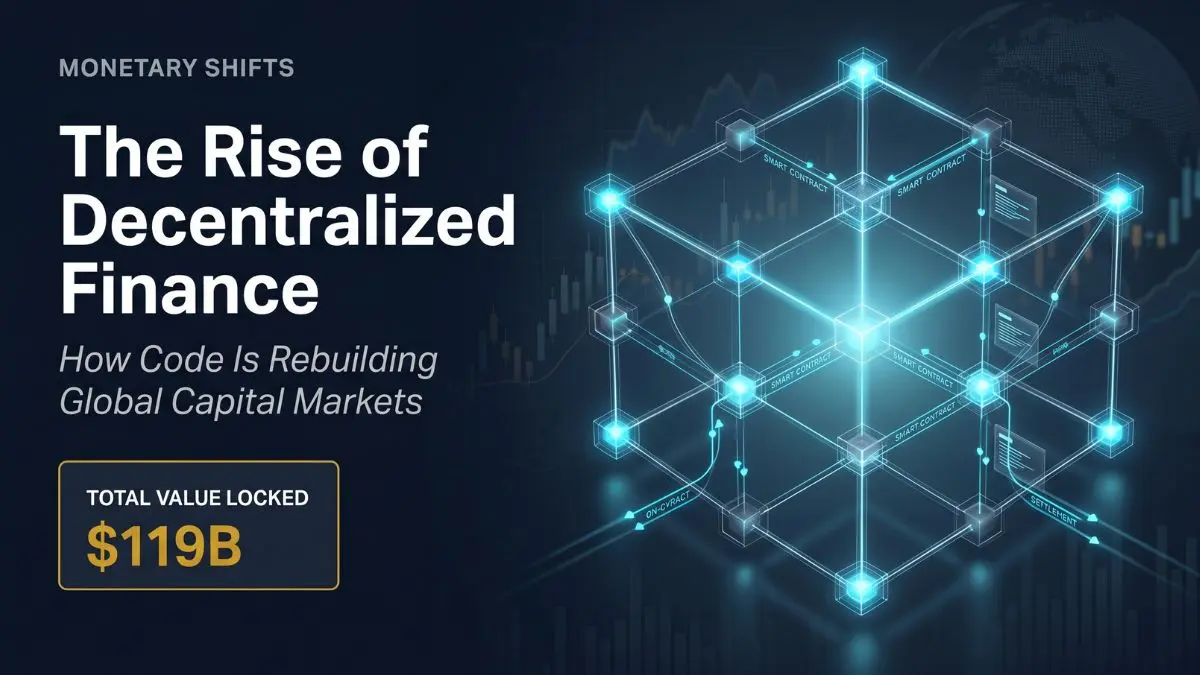
The scale is no longer trivial. As of early 2026, analytics platform DefiLlama tracks total value locked across DeFi protocols in the range of roughly $95 billion to $160 billion depending on methodology, with a figure near $119 billion cited by Chainalysis—more than double the sub-$40 billion trough reached in 2023. That recovery has unfolded alongside two structural shifts: the arrival of clear regulation, including the U.S. GENIUS Act signed in July 2025 and the EU’s MiCA framework, and the integration of stablecoins as the settlement layer of digital finance, now exceeding $250 billion in circulation. To understand this sector properly is also to understand its place within the broader global financial system, because the two are converging faster than most investors realize.
This guide explains what DeFi is, how its core building blocks work, where the real risks sit, how regulation is reshaping the sector, and how a serious investor should think about exposure. The goal is not hype but a durable mental model—one that connects DeFi to the broader currents of liquidity, monetary policy, and the evolving international financial system.
What Is DeFi? A Working Definition
DeFi is a category of financial applications that operate on permissionless blockchains, where the rules of each service are written into self-executing smart contracts rather than enforced by a company or regulator. A user interacts directly with the protocol from a self-custodied wallet, retaining control of their assets at every step. The defining features are non-custodial design, transparent on-chain settlement, composability between protocols, and open access regardless of geography or credit history.
The contrast with traditional finance is structural. A bank deposit is a liability of the bank; a DeFi deposit is a balance recorded in a smart contract whose code is public and whose collateral can be verified on-chain in real time. This shifts both the benefits and the risks. There is no account-freezing intermediary, but there is also no deposit insurance, no chargeback, and no help desk to reverse an error. Understanding that trade-off is the foundation of everything that follows. For readers newer to the broader asset class, a grounding in how crypto markets function as a whole is a useful companion to this material.
The Ideological and Macroeconomic Backdrop
DeFi did not emerge in a vacuum. It grew out of the same post-2008 skepticism toward centralized financial intermediaries that produced Bitcoin, and it accelerated during the cheap-money era when investors hunted for yield that traditional fixed income could not provide. As central banks—the Federal Reserve foremost among them—raised rates aggressively through 2022 and 2023, DeFi yields had to compete with risk-free Treasury bills for the first time, which is one reason capital efficiency and real revenue, rather than raw token incentives, now dominate how the sector is judged.
How Decentralized Finance Actually Works
At the base of every DeFi application sits a blockchain that provides settlement and a smart-contract environment. Ethereum remains the dominant venue, holding roughly half of all DeFi TVL, with Solana, BNB Chain, and Ethereum Layer-2 networks such as Base and Arbitrum splitting much of the remainder. On top of this base layer, four primitives do most of the work.
Decentralized exchanges (DEXs) let users swap one token for another without an order book or a custodian. Most rely on the automated market maker (AMM) model pioneered by Uniswap, in which liquidity providers deposit pairs of assets into a pool and a pricing formula sets the exchange rate algorithmically. Aggregate DEX monthly volumes have routinely run into the hundreds of billions of dollars, a scale that demonstrates DeFi is processing genuine economic activity rather than speculative noise.
Lending and borrowing markets such as Aave and the Sky protocol (formerly MakerDAO) allow users to deposit collateral and borrow against it, or to supply assets and earn interest, with rates set by supply and demand. Aave has at times held the largest protocol TVL in the sector, around $26 billion. Loans are typically overcollateralized—a borrower might lock $150 of crypto to borrow $100—because the protocol cannot pursue a defaulter in court and must instead liquidate collateral automatically when its value falls.
Liquid staking lets holders earn the rewards of securing a proof-of-stake network while keeping a tradeable receipt token. Lido, the largest such protocol, has held TVL in the $17–23 billion range. These receipt tokens, like stETH, can then be redeployed elsewhere in DeFi, which is the source of both the system’s capital efficiency and its most subtle risks.
Stablecoins are the unit of account that ties the whole system together, providing a dollar-denominated medium that lets users price, lend, and settle without exiting to a bank.
Composability: DeFi’s Superpower and Its Fault Line
The feature that makes DeFi distinct from a collection of separate apps is composability—the ability of protocols to plug into one another like interlocking modules, often described as “money legos.” A user can stake ETH with Lido, receive stETH, lend that stETH on Aave, and use the resulting position as collateral elsewhere, all in a few transactions. This stacking multiplies capital efficiency, but it also chains risks together: a failure or exploit in one protocol can cascade through every protocol built on top of it.
Stablecoins: The Settlement Layer of DeFi
No component matters more to DeFi’s function than stablecoins, dollar-pegged tokens that supply the liquidity and pricing reference the entire system depends on. By early 2026, dollar-pegged stablecoins in circulation reached roughly $230 billion to $280 billion, led by Tether’s USDT at around $142 billion and Circle’s USDC near $60 billion. To put that growth in perspective, the Brookings Institution notes the total stood near $25 billion in 2020.
The macroeconomic implications are striking. Because compliant issuers back their tokens largely with U.S. Treasury bills, the largest stablecoin reserves now rival those of mid-sized sovereign nations. Tether’s reported Treasury exposure would place it among the world’s twenty-largest holders of U.S. government debt. This connects DeFi directly to monetary policy and the demand dynamics of the Treasury market—a linkage with consequences far beyond crypto, and one any reader following inflation and global liquidity should track closely. The regulatory and stability dimensions of this linkage are examined in our analysis of stablecoin regulation and systemic risk.
What Is a Stablecoin?
A stablecoin is a cryptocurrency designed to hold a constant value, almost always pegged to a fiat currency such as the U.S. dollar, by backing each token with reserves like cash and short-term government bonds. Stablecoins let users move dollar-equivalent value across blockchains instantly and serve as the primary medium of exchange and collateral within decentralized finance.
Not all stablecoins share the same architecture. Fiat-collateralized coins like USDC and USDT hold reserves off-chain. Crypto-collateralized coins like Sky’s USDS are overcollateralized with on-chain assets. Algorithmic stablecoins, which attempted to hold their peg through supply mechanisms rather than reserves, have largely been discredited after high-profile collapses and are now explicitly excluded from major regulatory frameworks.
The Real Risks: Why DeFi Is Not Free Money
For all its promise, decentralized finance carries risks that differ in kind from those in traditional markets, and a credible investor’s guide must treat them squarely rather than burying them.
Smart-contract risk is foundational: if the code contains a flaw, funds can be drained irreversibly. The sector’s history is littered with exploits, though the trend is encouraging. Chainalysis reported that total crypto theft reached roughly $3.4 billion in 2025, but—in what it called a clear divergence from historical patterns—sector-specific hack losses stayed suppressed even as TVL rebounded. The firm attributed this to better monitoring, faster incident response, and governance mechanisms able to freeze or reverse attacks. In one 2025 case, the Venus protocol’s community passed a proposal that froze roughly $3 million still held by an attacker, leaving the hacker out of pocket.
Liquidation risk affects anyone borrowing against volatile collateral. Because DeFi loans are enforced by code, a sharp price drop can trigger automatic liquidation with no grace period, crystallizing losses in minutes during market stress.
Systemic and contagion risk flows directly from composability. The same stacking that boosts returns means a depeg or exploit in a foundational asset can ripple outward. Restaking and liquid-staking tokens introduce a related subtlety: the same underlying ETH can be counted in multiple protocols, so headline TVL can overstate the true capital at work. Analysts have estimated that a large share of deposited liquidity across major protocols is effectively dormant, generating no fees and overstating how much capital is genuinely productive.
Custody and key risk is now the dominant attack vector. Chainalysis found that personal-wallet compromises surged to roughly 158,000 incidents in 2025, and that the year’s losses were driven heavily by large private-key breaches at centralized services rather than DeFi protocol bugs—a reminder that in self-custodied finance, the user is their own security perimeter.
Why Are DeFi Hacks Decreasing While TVL Rises?
DeFi hack losses have stayed low even as deposited value recovered because protocols adopted stronger defenses: proactive on-chain monitoring, rapid response teams, formal audits, and governance that can act decisively to freeze stolen funds. As DeFi hardened, attackers shifted toward easier targets—individual wallets and centralized exchange private keys—which now account for the bulk of crypto theft today, according to Chainalysis.
The Regulatory Turning Point of 2025–2026
For a decade, regulatory uncertainty was the single largest obstacle to institutional participation in DeFi. That changed decisively in 2025 and 2026.
In the United States, the GENIUS Act—Guiding and Establishing National Innovation for U.S. Stablecoins—was signed into law on July 18, 2025, after clearing both chambers of Congress with bipartisan supermajorities. It created the country’s first federal framework for payment stablecoins, requiring full reserve backing with permitted assets, monthly disclosure, redemption rights, and a priority claim for holders in insolvency, while excluding algorithmic stablecoins from the definition entirely. The law explicitly classifies compliant payment stablecoins as neither securities nor commodities, removing a long-standing jurisdictional fog. Implementation rules are due by July 2026, and by late 2025 the Office of the Comptroller of the Currency had already granted conditional national trust bank charters to issuers including Circle and Paxos.
In Europe, the Markets in Crypto-Assets Regulation (MiCA) moved into full enforcement, with a hard deadline of July 1, 2026 for crypto-asset service providers to obtain authorization or exit the EU market. MiCA regulates stablecoins through two categories—e-money tokens and asset-referenced tokens—and imposes reserve, redemption, and disclosure requirements across the bloc. These regimes are part of a larger reshaping of the future of money, spanning CBDCs, stablecoins, and digital assets, in which this sector is one of the most consequential moving parts.
The combined effect of GENIUS and MiCA is a template that other jurisdictions, from Singapore and Hong Kong to the United Arab Emirates and Japan, are converging upon: licensed issuance, conservative reserves, enforceable redemption, and strong AML controls. For DeFi specifically, a regulated stablecoin layer functions as foundational infrastructure, lowering the barrier for the institutional capital that had stayed on the sidelines. This regulatory clarity arrives at a moment when institutional adoption of digital assets, visible in the rise of the Bitcoin spot ETF, is reshaping who participates in crypto markets.
What Is the GENIUS Act?
The GENIUS Act is a U.S. federal law enacted on July 18, 2025, that establishes the first national regulatory framework for payment stablecoins. It requires issuers to hold 100% reserves in permitted assets, obtain a federal license, undergo regular audits, and grant holders priority claims in insolvency. The law treats compliant payment stablecoins as neither securities nor commodities and excludes algorithmic stablecoins.
DeFi for Investors: Sources of Return and How to Think About Them
Investors approach DeFi for several distinct return streams, each with its own risk profile. Lending yields come from borrowers paying interest, and they tend to track demand for leverage; they are relatively transparent but compress when borrowing demand falls. Liquidity-provision returns come from trading fees in DEX pools, offset by impermanent loss—the cost a liquidity provider bears when the two pooled assets diverge in price. Staking and liquid-staking rewards come from securing proof-of-stake networks, paid in the network’s native token. Token incentives, sometimes called yield farming, are protocol-issued rewards designed to bootstrap usage; they are the least durable source of return and often mask thin underlying revenue.
The mature framing, increasingly adopted across 2024–2026, is to distinguish real yield—returns funded by genuine protocol fees and revenue—from incentive yield funded by token emissions that dilute holders. A protocol generating substantial fees relative to its TVL is structurally healthier than one whose headline APY depends on printing its own token. This is why serious analysts cross-check TVL against fees, revenue, and active users rather than chasing the highest advertised rate. Yield also carries reporting obligations — staking rewards and farming income are generally taxable on receipt, a topic covered in our guide to crypto taxation basics.
A Practical Risk Checklist for DeFi Exposure
- Verify the audit trail. Confirm the protocol has been audited by reputable firms and check whether findings were resolved.
- Distinguish real yield from emissions. Ask where the return actually comes from; if it is purely token incentives, treat it as temporary.
- Assess collateralization and liquidation parameters before borrowing against volatile assets.
- Map composability exposure. Understand which other protocols your position depends on, since their failure becomes your failure.
- Prioritize self-custody hygiene. With personal-wallet compromises now the leading loss vector, hardware wallets and disciplined key management matter more than protocol selection.
- Size positions for total loss. Treat any single on-chain position as capable of going to zero, and size accordingly.
DeFi and the Broader Monetary System
The most consequential way to view decentralized finance is not as a set of trading apps but as an emerging parallel financial infrastructure with direct ties to the traditional system. Stablecoin reserves channel real demand into U.S. Treasuries, linking crypto liquidity to sovereign debt markets. Tokenization of real-world assets is pulling traditional instruments on-chain. And the regulatory frameworks of 2025–2026 are deliberately designed to integrate, rather than wall off, these rails from mainstream finance.
This integration cuts both ways. It brings the legitimacy and capital that DeFi needs to mature, but it also imports the very intermediation and oversight that DeFi was originally built to escape. The likely 2026–2030 trajectory is a hybrid system: permissionless protocols at the base, with regulated issuers, licensed venues, and institutional custodians layered on top—a structure that would have seemed contradictory to DeFi’s earliest builders but that reflects how genuinely disruptive technologies are typically absorbed by the financial system rather than replacing it. For investors weighing how this fits a portfolio that may also include hard assets like gold, the key is to see DeFi as one expression of a longer shift in how value is stored and moved globally.
People Also Ask
Is DeFi safe for beginners? Decentralized finance is accessible to beginners but carries meaningful risks that traditional savings products do not, including smart-contract bugs, liquidation, and irreversible transactions. There is no deposit insurance and no intermediary to reverse mistakes. Beginners should start with small amounts, use well-audited and established protocols, prioritize self-custody security, and understand that the user bears full responsibility for their funds.
How is DeFi different from a bank? A bank holds your deposit as its own liability and intermediates every transaction, offering insurance and recourse but also control over your account. It records your balance in a public smart contract that you access directly from a self-custodied wallet, giving you full control and transparency but no insurance, no chargebacks, and no help desk. The trade-off is autonomy versus protection.
What is total value locked (TVL)? Total value locked is the aggregate U.S.-dollar value of all crypto assets deposited in a DeFi protocol’s smart contracts at a given moment. It is the sector’s headline adoption metric, signaling liquidity and user trust. TVL can be misleading, however, because liquid-staking and restaking tokens are sometimes counted more than once, and high TVL does not guarantee a protocol earns meaningful revenue.
Do you need a lot of money to use DeFi? No. DeFi protocols are permissionless and generally have no minimum balance, so a user can interact with very small amounts. The practical constraint is transaction fees: on congested networks like Ethereum mainnet, fees can make tiny transactions uneconomical, which is why many smaller users operate on lower-cost Layer-2 networks such as Base or Arbitrum.
Are stablecoins regulated now? Yes, increasingly so. The U.S. GENIUS Act of July 2025 created a federal framework for payment stablecoins, and the EU’s MiCA regulation requires authorization by July 1, 2026. Both mandate full reserve backing, disclosure, and redemption rights. Compliant stablecoins like USDC are gaining institutional preference, while algorithmic stablecoins are excluded from these frameworks.
Conclusion
Decentralized finance has matured from a fringe experiment into financial infrastructure that secures well over $100 billion and processes real economic volume. The core lesson for investors is that DeFi’s defining feature—removing intermediaries through code—is simultaneously its greatest advantage and its greatest risk: it offers open, transparent, programmable access to capital markets, but it places the full burden of security and judgment on the user. With the regulatory clarity of the GENIUS Act and MiCA now reshaping the landscape and institutional capital arriving, DeFi is being woven into the broader monetary system rather than replacing it. The next step is to deepen your understanding of the building blocks—stablecoins, lending markets, and the assets underneath them—before committing capital.
Disclaimer
This article is for educational and informational purposes only and does not constitute financial, investment, legal, or tax advice. Decentralized finance involves substantial risk, including the potential total loss of capital, smart-contract failure, and regulatory change. Statistics cited reflect data available as of early 2026 and change continuously. Always conduct your own research and consult a qualified, licensed professional before making any investment decision. Monetary Shifts is not a licensed financial advisor.
FAQ
What does “decentralized” actually mean in decentralized finance? Decentralization in DeFi refers to the absence of a single controlling intermediary in the operation of a financial service. Instead of a bank or broker executing and guaranteeing transactions, the rules are encoded in smart contracts that run autonomously on a public blockchain, and the assets are held in self-custodied wallets rather than on a company’s balance sheet. In practice, decentralization exists on a spectrum: some protocols are governed by broadly distributed token-holder communities, while others retain significant developer or foundation control over upgrades and emergency functions. Investors should examine the actual governance and admin-key arrangements of any protocol rather than assuming the “decentralized” label guarantees there is no central point of failure.
How do DeFi lending protocols set interest rates? DeFi lending markets such as Aave use algorithmic interest-rate models driven by utilization—the ratio of borrowed funds to supplied funds in a given asset pool. When a high proportion of available capital is borrowed, rates rise automatically to attract more suppliers and discourage further borrowing; when utilization falls, rates decline. This produces transparent, real-time pricing that adjusts continuously without a committee or central authority. Because the process is fully automated and overcollateralized, the protocol can operate without credit checks, but it also means rates can move sharply during periods of high demand for leverage or market stress.
What is impermanent loss and why does it matter? Impermanent loss is the opportunity cost a liquidity provider experiences when the prices of the two assets in a pool diverge after deposit. Because an automated market maker continuously rebalances the pool, the provider ends up holding relatively more of the asset that fell in value and less of the one that rose, leaving them worse off than if they had simply held both tokens. It is called “impermanent” because the loss only crystallizes upon withdrawal and can shrink if prices converge again. The trading fees earned from providing liquidity are meant to offset this effect, so the practical question for an investor is whether expected fee income exceeds expected divergence loss.
How does DeFi connect to traditional macroeconomics? DeFi is increasingly intertwined with the traditional financial system through several channels. Stablecoin issuers hold large reserves of U.S. Treasury bills, making them meaningful sources of demand in the government-debt market and linking crypto liquidity to interest-rate policy set by the Federal Reserve. When risk-free rates rise, DeFi yields must compete with safe Treasury returns, which dampens speculative inflows; when rates fall, capital tends to rotate back toward higher on-chain yields. This dynamic is part of a broader story about how Bitcoin and crypto challenge the traditional financial system, of which decentralized finance is the institutional-grade extension. Tokenization of real-world assets and the integration of regulated stablecoins further blur the line between on-chain and off-chain finance, meaning macroeconomic conditions and DeFi activity now influence one another directly.
Can DeFi transactions be reversed or recovered? Generally no. Transactions confirmed on a blockchain are immutable by design, which means a mistaken transfer, an interaction with a malicious contract, or funds sent to the wrong address usually cannot be undone. This is a deliberate property that removes the need for a trusted intermediary, but it places enormous responsibility on the user. The notable exception is when a protocol’s governance community holds emergency powers and chooses to act—as occurred in 2025 when some protocols froze attacker-controlled funds—but such interventions are protocol-specific, not a general guarantee. The safest assumption is that any DeFi transaction is final and irreversible.
Why do most DeFi loans require more collateral than the amount borrowed? DeFi lending protocols are overcollateralized because they have no legal recourse against a borrower who fails to repay. In traditional finance, a lender can pursue a defaulter through the courts; a smart contract cannot. To protect suppliers, the protocol instead requires borrowers to lock collateral worth more than the loan—often 130% to 200% of the borrowed value—and automatically liquidates that collateral if its value falls toward the loan amount. This design makes the system self-enforcing and trustless, but it also means DeFi credit is currently most useful for users who already hold crypto assets and want liquidity without selling, rather than for those seeking unsecured credit.
What role do Layer-2 networks play in DeFi? Layer-2 networks are blockchains built on top of a base layer like Ethereum to process transactions faster and far more cheaply while inheriting the security of the underlying chain. They matter for DeFi because high transaction fees on Ethereum mainnet can make small interactions uneconomical, excluding many users. Networks such as Base and Arbitrum have absorbed a growing share of DeFi activity by offering fees a fraction of mainnet costs, broadening access and enabling use cases—like frequent small trades or micro-lending—that would be impractical otherwise. Their rise is a key reason DeFi has continued to grow even as it pushes toward mainstream adoption.
Is the high yield advertised by some DeFi protocols real? Sometimes, but it must be scrutinized. Advertised annual percentage yields can come from two very different sources: genuine protocol revenue (fees paid by real users) or token incentives (newly issued tokens distributed to attract deposits). Yield funded by real revenue is sustainable; yield funded by token emissions dilutes existing holders and typically collapses once incentives end. Headline rates can also be inflated by short-term promotions or by counting the same capital across stacked protocols. The disciplined approach is to investigate the fee and revenue data behind a yield—using independent analytics rather than the protocol’s own marketing—before assuming an advertised return is durable.
How much of crypto activity is actually illicit? Despite high-profile hacks, illicit transactions consistently represent a small fraction of total crypto volume—well under 1% by most analyses. The headline theft figures, such as the roughly $3.4 billion stolen in 2025 reported by Chainalysis, are concentrated in a handful of very large incidents, and a significant share is attributed to state-linked actors targeting centralized services rather than DeFi protocols themselves. For investors, the practical takeaway is that systemic illicit activity is not the primary risk; the primary risks are operational—smart-contract bugs, personal-wallet compromise, and poor security hygiene—which are largely within a careful user’s control.

About Financial Cryptarch
Financial Cryptarch is the Founder of Criptocurrencie and a finance professional with over 15 years of experience in Accounting and Corporate Finance. Holding a Bachelor’s Degree in Accounting and an MBA in Corporate Finance, he focuses on cryptocurrencies, macroeconomics, global finance, and international geopolitics, helping readers understand the forces shaping money, markets, and economic power.


