
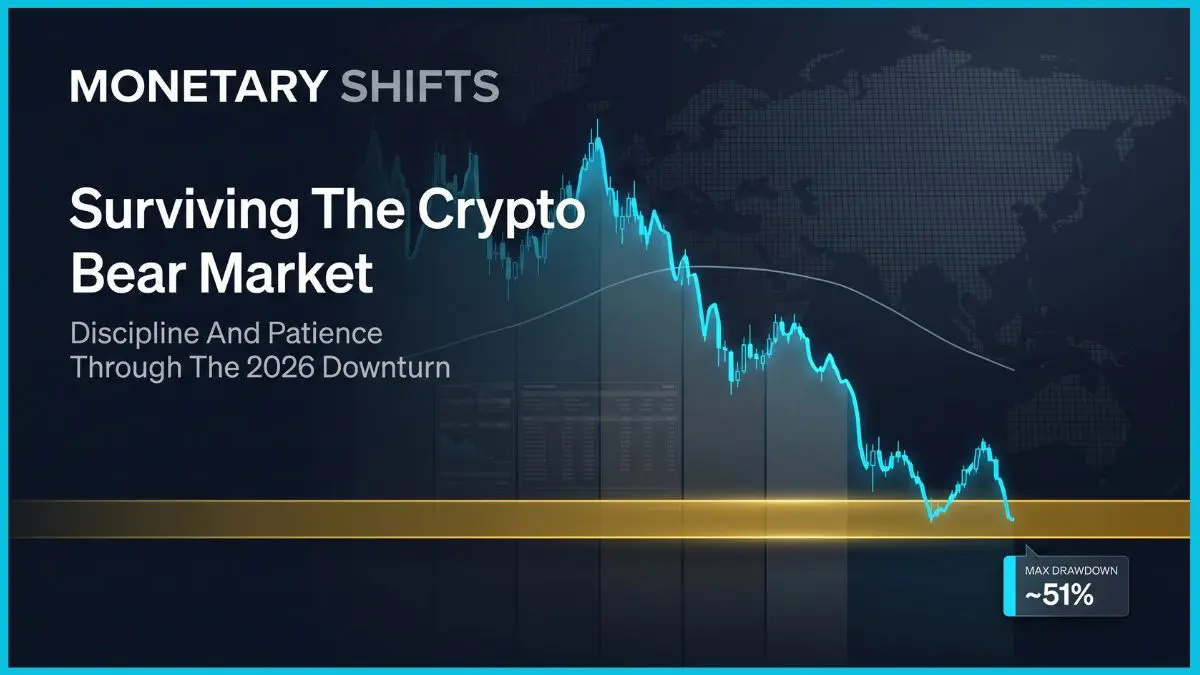
A crypto bear market strategy is a structured plan that protects long-term capital during sustained price declines. It combines dollar-cost averaging, disciplined asset selection, liquidity reserves, and emotional control. The goal is not to time the exact bottom, but to accumulate quality assets and preserve solvency until the next cycle recovery begins.
Introduction
The 2025–2026 downturn has tested even seasoned investors. After Bitcoin peaked near $126,000 in October 2025, the market reversed sharply, and by late June 2026 prices had fallen roughly 50% from that high. A disciplined crypto bear market strategy is what separates investors who compound through cycles from those who capitulate at the worst possible moment. According to CoinGecko research, the current episode has so far registered a maximum drawdown of about 51%, making it the mildest bear market on record relative to Bitcoin’s prior cycles. That comparative resilience reflects deeper institutional participation, established ETF infrastructure, and a maturing market structure. This guide explains how long-term investors can navigate the downturn with a framework grounded in historical data, on-chain evidence, and risk management rather than fear.
What Is a Crypto Bear Market?
A crypto bear market is a sustained period of declining digital asset prices, typically defined by a drop of 20% or more from a recent peak, accompanied by widespread pessimism and risk-off sentiment. It differs from a brief correction because it persists for months, breaks long-term moving averages, and reshapes investor behavior across the market.
Bear markets are a recurring feature of every crypto cycle. The most recent complete one ran from November 2021 to November 2022, lasting roughly twelve months and producing a drawdown near 77%. Historically, these phases have lasted between nine and eighteen months, with a median around twelve. The current cycle, which began after the October 2025 top, fits this pattern but has so far been notably shallower than its predecessors. Analysts at firms such as CryptoQuant and Glassnode broadly point to a probable bottom window in the second half of 2026, though no model can pinpoint an exact low.
A defining structural difference in 2026 is the role of institutional capital. With spot Bitcoin ETFs now established financial infrastructure, large allocators and corporate treasuries influence supply and demand in ways that did not exist during earlier downturns. This participation may compress the depth and duration of bear markets compared with cycles dominated by retail panic.
Why Bear Markets Happen: Macro and On-Chain Drivers
Understanding the forces behind a downturn helps investors respond rationally rather than emotionally. The 2025–2026 decline has been driven by a combination of macroeconomic tightening, capital rotation, and shifting institutional flows.
The macro backdrop has been the dominant factor. Persistent inflation concerns, uncertainty around the Federal Reserve interest rate path, and geopolitical tension have all weighed on risk assets. Because Bitcoin now trades heavily as a risk asset, tighter monetary conditions and reduced global liquidity have amplified selling pressure. When real returns on safe assets rise, speculative capital tends to retreat.
Capital rotation has added a second engine. Through much of 2026, investment flowed out of crypto and into artificial intelligence equities, with memory-chip and AI-focused funds attracting billions while Bitcoin ETFs experienced redemptions. This rotation deepened the drawdown beyond what the cycle alone would have produced.
On the institutional side, the data reveals a clear divergence. According to Glassnode Strategy Watch data, U.S. spot Bitcoin ETFs recorded their largest monthly outflows on record during May 2026, even as digital asset treasuries continued accumulating. Spot Bitcoin ETFs have attracted more than $58 billion in cumulative net inflows since their January 2024 launch, yet short-term flows turned sharply negative as allocators de-risked. The critical question for any long-term investor is whether holders absorb the coins that ETF sellers shed.
On-Chain Signals That Define Where We Are in the Cycle
On-chain analysis provides evidence that price action alone cannot. Several metrics help long-term investors gauge whether a bear market is maturing toward a bottom or has further to fall.
Long-term holder behavior is among the most reliable signals. Through the 2026 drawdown, wallets that have survived previous bear markets posted some of their largest accumulation on record, suggesting experienced capital views current prices as attractive. When long-term holders accumulate while weaker hands sell, on-chain structure is generally considered intact.
Funding rates offer another window. Bitcoin’s perpetual futures funding rate had been negative for an extended stretch during 2026, reflecting persistent bearish positioning. Historically, prolonged negative funding tends to exhaust selling pressure rather than fuel further declines, often coinciding with local bottoms.
The 200-week moving average has long acted as a structural support zone across Bitcoin cycles. As of mid-2026, this level sat near $60,000, and price swept below it before reclaiming the zone—behavior that has historically accompanied cycle bottoms in formation. Meanwhile, the 200-day moving average, near $76,000, has functioned as overhead resistance. Reclaiming it on a sustained basis would be an important technical confirmation that the trend is turning. These signals do not guarantee a bottom, but together they describe a market deep into bear territory rather than at the start of one.
Core Strategies to Survive a Crypto Bear Market
A resilient crypto bear market strategy rests on a handful of disciplined practices. The objective is capital preservation and patient accumulation, not heroic bottom-calling.
Dollar-cost averaging (DCA). Spreading purchases across the expected bottom window smooths entry prices and removes the pressure of timing the exact low. Investors who began DCA during periods of extreme fear in past cycles captured substantial cumulative returns during subsequent recoveries.
Quality asset selection. Bear markets expose weak projects. Concentrating on assets with durable network effects, real usage, and proven resilience reduces the risk of permanent capital loss. A diversified crypto portfolio anchored in established assets tends to weather downturns better than speculative concentration.
Liquidity reserves. Holding cash or stablecoins preserves the ability to buy deeper dips. Reserves also reduce the temptation to panic-sell core positions to raise cash. Investors should understand the distinctions in crypto exchange safety and custody before parking reserves anywhere.
Secure custody. A prolonged downturn is the right time to review storage. Strong crypto wallet security practices and an understanding of cold storage vs hot wallet trade-offs protect holdings regardless of price.
Emotional discipline. Bottoms form in fear. Avoiding leverage, ignoring short-term noise, and committing to a written plan are historically the single biggest determinants of long-term performance.
Bear Market Survival Checklist
- Define a fixed DCA schedule and automate it where possible.
- Set staggered limit orders at major support levels rather than chasing one target.
- Maintain a liquidity reserve sized to your risk tolerance.
- Review custody and security before deploying capital.
- Avoid leverage and emotional, news-driven decisions.
- Keep records to evaluate decisions objectively after the cycle.
Comparing Bear Market Approaches
Not every approach suits every investor. The table below contrasts common strategies long-term holders use during downturns.
| Strategy | How It Works | Best For | Main Risk |
|---|---|---|---|
| Dollar-cost averaging | Fixed purchases at set intervals | Long-term accumulators | Capital tied up early in a deep decline |
| Lump-sum buying | Single large entry near perceived support | High-conviction investors | Mistiming the bottom |
| Cash-and-wait | Hold reserves, deploy on confirmation | Risk-averse investors | Missing the sharp early recovery |
| Active hedging | Reduce exposure, use downside protection | Experienced, active investors | Complexity and execution cost |
The most resilient plans often blend these: a DCA core, a liquidity reserve for deeper dips, and a focus on quality assets.
What Are the Best Assets to Hold in a Crypto Bear Market?
The most defensible holdings in a downturn are assets with the deepest liquidity, strongest network effects, and clearest institutional adoption. Bitcoin and, to a lesser degree, large established networks have historically led recoveries first. Stablecoins serve as a defensive reserve, allowing investors to stay liquid and deploy capital when conviction signals align.
People Also Ask
How long does a crypto bear market last? Historically, crypto bear markets have lasted between nine and eighteen months, with a median near twelve. The current cycle began after the October 2025 peak, and most analysts expect a probable bottom in the second half of 2026, though timing remains uncertain and depends heavily on macro conditions.
Should I sell my crypto during a bear market? For long-term investors, panic-selling near a bottom has historically been the most damaging decision. Bear markets tend to bottom in periods of extreme fear. A structured plan based on accumulation and liquidity management generally outperforms emotional exits, though every investor’s situation differs.
Is the 2026 crypto bear market worse than 2022? No. The 2022 downturn produced a drawdown near 77%, while the 2025–2026 decline has so far reached roughly 51%, making it the mildest on record relative to prior cycles. Deeper institutional participation and ETF infrastructure are widely cited as structural reasons.
What is dollar-cost averaging in crypto? Dollar-cost averaging means buying a fixed dollar amount at regular intervals regardless of price. It smooths the average entry cost across a volatile period and removes the need to predict the exact bottom, making it a foundational tool in any crypto bear market strategy.
Do Bitcoin ETFs affect bear markets? Yes. Spot Bitcoin ETFs now act as structural infrastructure, and their flows influence supply and demand. Large outflows can deepen short-term declines, while sustained inflows support recovery. Many analysts believe ETF participation may make modern bear markets shallower or shorter than earlier cycles.
Conclusion
A crypto bear market strategy is ultimately about discipline rather than prediction. The 2025–2026 downturn, while painful, has been the mildest on record relative to Bitcoin’s prior cycles, supported by institutional adoption and ETF infrastructure that did not exist before. Long-term investors who rely on dollar-cost averaging, quality asset selection, liquidity reserves, and emotional control position themselves to compound through the cycle rather than capitulate within it. The next step is to define a written plan, automate it, and revisit your custody and security setup so you are ready when the recovery arrives.
Important Notice: This content is for educational and informational purposes only and does not constitute financial, investment, legal, or tax advice. Cryptocurrencies are high-risk, highly volatile assets; past performance does not guarantee future results. Do your own research and, before making any investment decision, consult a licensed professional.

About Financial Cryptarch
Financial Cryptarch is the Founder of Criptocurrencie and a finance professional with over 15 years of experience in Accounting and Corporate Finance. Holding a Bachelor’s Degree in Accounting and an MBA in Corporate Finance, he focuses on cryptocurrencies, macroeconomics, global finance, and international geopolitics, helping readers understand the forces shaping money, markets, and economic power.


