Introduction
The relationship between inflation and housing is one of the most consequential dynamics in modern macroeconomics — and one that millions of households experience firsthand every time they check mortgage rates or rental listings.
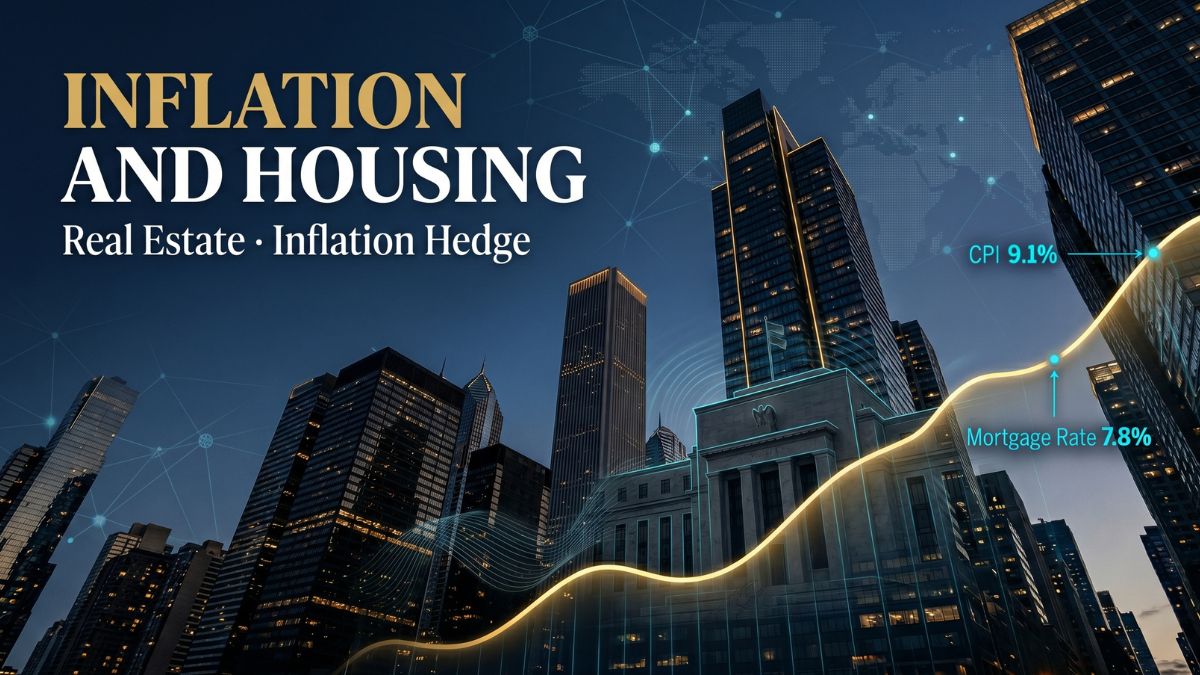
When the U.S. Consumer Price Index (CPI) surged to 9.1% in June 2022 — its highest level since 1981, according to the U.S. Bureau of Labor Statistics — shelter costs were among the primary drivers. Housing-related expenses now account for approximately 34% of the CPI basket, making it the single largest component of measured inflation.
The Federal Reserve’s aggressive response — raising the federal funds rate from near zero to over 5% between 2022 and 2023 — sent mortgage rates above 7% for the first time in over two decades. The result was a dramatic affordability crisis that reshaped both the rental and ownership markets globally.
Understanding how inflation interacts with housing demand, supply, construction costs, and monetary policy is essential for any investor, homebuyer, or financial analyst navigating the current economic environment.
How Inflation Directly Impacts Housing Costs
Inflation affects housing through multiple simultaneous channels, each reinforcing the others in a way that makes real estate particularly sensitive to monetary conditions.
Construction costs rise with inflation as the prices of raw materials — steel, lumber, concrete, copper — increase alongside labor costs. According to the U.S. Census Bureau, residential construction costs increased by over 30% between 2020 and 2023, driven by supply chain disruptions, commodity inflation, and wage growth in the trades sector. This directly limits new housing supply at the exact moment demand is most acute.
Land prices also respond to inflation expectations. Developers and investors often treat land as a store of value during inflationary periods, pushing prices higher even before a single foundation is poured.
Operating costs for landlords — maintenance, insurance, property taxes — increase with general price levels, and these costs are typically passed on to tenants through higher rents. The IMF’s World Economic Outlook has repeatedly flagged rental inflation as a structurally persistent component of core inflation in advanced economies, noting that rent adjustments typically lag overall inflation by 12 to 18 months, prolonging inflationary cycles even after headline CPI begins to moderate.
The Supply-Demand Imbalance
Inflation compounds an already critical housing supply shortage in most developed economies. The National Association of Realtors (NAR) estimated a deficit of approximately 5.5 million housing units in the United States as of 2023. When inflation raises construction costs simultaneously, the gap widens further.
This structural undersupply creates a self-reinforcing dynamic: prices rise, demand is suppressed but not eliminated, and the backlog of unmet housing need grows. The result is sustained price pressure that persists even as inflation elsewhere in the economy moderates.
Interest Rates, Mortgages, and Affordability
The most immediate mechanism through which inflation affects housing is through monetary policy — specifically, the central bank’s response to rising prices.
When inflation exceeds target levels, central banks such as the Federal Reserve, the European Central Bank (ECB), and the Bank of England raise policy interest rates. This increases the cost of borrowing across the economy, and nowhere is this felt more acutely than in residential mortgages.
Between early 2022 and late 2023, the average 30-year fixed mortgage rate in the United States rose from approximately 3.1% to over 7.8%, according to Freddie Mac data. This single factor reduced the purchasing power of a median American homebuyer by nearly 35%, pricing millions of households out of ownership markets and into rental markets — further increasing rental demand and rent prices.
The Bank for International Settlements (BIS) documented in its 2023 Annual Economic Report that the rapid rate transmission into housing markets was faster in this cycle than in previous inflationary episodes, partly due to the prevalence of variable-rate mortgages in countries like Canada, Australia, and the United Kingdom, where households faced immediate payment increases.
The “Lock-In Effect”
A distinctive feature of this inflationary cycle was the so-called “lock-in effect.” Homeowners who had secured mortgages at 2-3% rates between 2020 and 2021 were effectively frozen in place — selling would mean taking on a new mortgage at double or triple the original rate.
This suppressed listing inventory dramatically, reducing the number of homes available for purchase. According to Zillow Research, active inventory in the United States fell to historically low levels in 2023 precisely because existing homeowners chose not to sell. Tight supply, even in the face of reduced demand, kept prices elevated.
Housing as an Inflation Hedge: Fact or Myth?
Real estate has long been marketed as a natural hedge against inflation — an asset whose value rises alongside general price levels. The historical record partially supports this view, but with important caveats.
Over long time horizons, home prices in most developed economies have broadly tracked inflation, preserving real purchasing power. Commercial real estate and residential rental properties provide an additional hedge through lease escalation clauses, which allow landlords to increase rents in line with CPI.
However, the experience of 2022-2024 illustrated the limitations of this framing. Nominal home prices in many markets did rise initially, but when adjusted for inflation, real home values declined in several major markets including parts of the United States, Canada, Germany, and Sweden. The World Bank’s Global Economic Prospects highlighted that in interest-rate-sensitive economies, housing corrections during high-inflation periods can be sharp and rapid.
| Market | Peak Nominal Price Gain (2020–2022) | Real Price Change (Inflation-Adjusted, 2022–2023) |
|---|---|---|
| United States | +42% | -8% to -12% |
| Canada | +54% | -15% to -20% |
| Germany | +38% | -10% to -14% |
| Sweden | +31% | -20% to -25% |
| Australia | +29% | -5% to -10% |
Sources: OECD Housing Price Index, national statistics offices.
The conclusion is nuanced: real estate is a reasonable inflation hedge over the long term, but the transition period — when central banks are actively raising rates — creates a window of genuine price risk.
Global Perspectives: Emerging Markets and the Housing Inflation Dynamic
The interaction between inflation and housing is not uniform across economies. In emerging markets, the dynamics are often more severe.
In countries like Turkey, Argentina, and Brazil, where inflation has periodically exceeded 50-100% annually, housing markets exhibit extreme dislocation. Nominal prices rise rapidly in local currency terms, but real values may stagnate or decline when measured in USD or adjusted for purchasing power parity.
Brazil’s experience is instructive. The IBGE (Instituto Brasileiro de Geografia e Estatística) reported that housing costs were a persistent driver of the IPCA inflation index through 2022-2023, even as the Banco Central do Brasil raised the Selic rate to 13.75% — one of the highest real interest rates among major economies. The result was a housing market where rental demand remained strong (buyers priced out) while new construction stalled (financing too expensive for developers).
In China, the dynamic ran in the opposite direction. Deflation concerns emerged alongside a housing market collapse tied to over-leveraged property developers including Evergrande. The People’s Bank of China (PBOC) faced the unusual challenge of stimulating a housing sector in contraction while managing capital outflows — illustrating that the relationship between monetary conditions and housing is not always inflationary.
The OECD’s Housing Policy Toolkit notes that structural housing shortages are a global phenomenon, with most member countries facing long-term supply deficits that are unlikely to be resolved by demand-side monetary policy alone.
Rental Inflation: The Shelter Component and Its Persistence
Of all the ways inflation manifests in housing, rental inflation — what economists call “shelter inflation” — may be the most politically and economically significant.
In the United States, the shelter component of CPI is measured using Owner’s Equivalent Rent (OER) and actual rent data. Because these measures are calculated based on surveyed rents with significant lags, they tend to understate rapid rent increases in real time and then overstate them on the way down — creating a “ghost inflation” problem that complicates central bank decision-making.
The Federal Reserve’s preferred inflation gauge, the Personal Consumption Expenditures (PCE) index, weights shelter somewhat lower than CPI, but both measures were significantly elevated in 2022-2023 due to rental price acceleration.
Private sector data from Apartment List, Zillow, and CoreLogic showed annual rent growth exceeding 15% in some U.S. metropolitan areas in 2021-2022 — driven by pandemic migration patterns, remote work flexibility, and the suppressed mortgage market pushing more households into rentals.
This rental inflation feeds back into broader price pressures because housing costs represent such a large share of household budgets. When rents rise, workers demand higher wages to maintain living standards, creating the “wage-price spiral” that central banks are particularly determined to prevent.
People Also Ask
Does inflation cause house prices to go up? Inflation generally pushes nominal house prices higher because construction costs, land values, and replacement costs all increase with general price levels. However, when inflation triggers aggressive central bank rate hikes, mortgage costs rise sharply, reducing demand and purchasing power. The net effect depends on the magnitude of inflation, the speed of monetary tightening, and local supply conditions — making the relationship complex rather than linear.
How does inflation affect rental prices? Inflation increases rental prices through multiple channels: higher operating costs for landlords (maintenance, insurance, property taxes), increased construction costs limiting new rental supply, and monetary tightening pricing potential buyers into the rental market. Rental inflation tends to be sticky and persistent, often lagging headline CPI by 12-18 months, which means rent increases can continue even after broader inflation begins to moderate.
Is buying a house a good hedge against inflation? Historically, real estate has preserved purchasing power over long horizons because it is a tangible asset with intrinsic utility and supply constraints. However, during active monetary tightening cycles, rising mortgage rates reduce affordability and can cause nominal price corrections. The hedging effectiveness of housing depends on the type of financing, the local market, and the investor’s time horizon — it works better as a multi-decade hold than as a short-term inflation trade.
What happens to mortgages during inflation? Existing fixed-rate mortgages benefit from inflation in real terms — the borrower repays in inflated, less-valuable currency while the lender receives fixed payments worth less in real terms. New mortgages, however, are priced at elevated rates that reflect inflation expectations and central bank policy. This creates a stark divide between existing homeowners (who benefit) and new buyers (who face significantly higher costs).
How did the Federal Reserve’s rate hikes affect housing? The Federal Reserve’s rate hike cycle from March 2022 to mid-2023 raised the federal funds rate from 0.25% to over 5.25%. This caused 30-year mortgage rates to exceed 7.5%, reducing buyer affordability by approximately 35% from peak purchasing power. The result was a significant decline in home sales volume, a lock-in effect reducing inventory, and a bifurcated market where prices remained elevated in supply-constrained markets while correcting more sharply in previously overheated markets.
Conclusion
The relationship between inflation and housing is one of the central fault lines of modern macroeconomics — complex, consequential, and deeply felt by households across income levels. Rising inflation increases construction costs, land prices, and operating expenses, pushing both home prices and rents higher. Simultaneously, the monetary policy response to inflation — higher interest rates — increases mortgage costs and reduces affordability, suppressing demand and creating conditions for market corrections.
The 2020-2024 global experience demonstrated that housing markets can be caught between two powerful and contradictory forces simultaneously: supply shortages supporting prices on one side, and affordability destruction through higher rates on the other. Understanding this tension is essential for investors, policymakers, and households making long-term financial decisions.
For a broader understanding of the inflationary forces driving these dynamics, explore Inflation Explained: What It Is and Why Prices Rise — the foundational pillar covering monetary policy, central bank behavior, and the mechanisms of price instability that underlie housing market volatility.
To deepen your knowledge, read our full article on the subject. Inflation Explained: What It Is, What Causes It, and How It Affects You
FAQ
What is the relationship between the Consumer Price Index and housing costs? The Consumer Price Index (CPI) includes housing-related costs — primarily through the shelter component, which encompasses Owner’s Equivalent Rent (OER) and actual rents. In the United States, shelter represents approximately 34% of the CPI basket, making it the single largest component. Because rental surveys are conducted with a lag and averaged over time, official inflation data tends to understate rapid rent acceleration in real time and overstate moderation on the way down, creating measurement challenges for policymakers attempting to calibrate monetary responses.
Can cryptocurrency or Bitcoin serve as an alternative to real estate as an inflation hedge? Bitcoin and other cryptocurrencies have been proposed as digital alternatives to real estate as inflation hedges, based on their fixed supply characteristics (Bitcoin’s 21 million coin cap). In practice, the correlation between Bitcoin and traditional inflation hedges has been inconsistent. During the 2022 inflation spike, Bitcoin declined sharply alongside risk assets while real estate initially maintained nominal values. However, over longer multi-year periods, Bitcoin has significantly outperformed both inflation and real estate in appreciation terms, though with vastly higher volatility — making it a speculative rather than defensive position for most investors.
How does housing inflation affect renters differently from homeowners? Renters are more directly exposed to short-term housing inflation because their costs reset at each lease renewal, typically reflecting current market rents. Homeowners with fixed-rate mortgages are largely insulated from housing cost inflation in the short term — their monthly payment is locked in, and inflation may actually erode the real value of their debt. However, homeowners face exposure through rising property taxes (which typically adjust to reflect home values), insurance costs, and maintenance expenses. Long-term renters in markets without rent stabilization policies are particularly vulnerable during inflationary cycles.
What role does housing supply play in long-term inflation dynamics? Housing supply constraints are a structural driver of persistent inflation in many economies. When supply cannot expand quickly enough to meet demand — due to zoning restrictions, construction cost increases, labor shortages, or financing barriers — prices respond primarily through price increases rather than quantity increases. The OECD has documented that countries with more restrictive planning systems tend to exhibit higher and more persistent housing inflation than those with more liberalized development frameworks. Addressing supply-side barriers is considered by most economists to be essential to achieving durable housing affordability, regardless of monetary conditions.
How do BRICS countries experience the inflation-housing relationship differently than Western economies? In BRICS economies, the inflation-housing dynamic is shaped by additional factors including currency volatility, lower institutional mortgage market development, higher share of informal housing, and varying central bank credibility. In Brazil and India, informal housing markets operate partially outside formal price measurement, making housing inflation harder to quantify accurately. In China, the housing sector’s extraordinary size relative to GDP — estimated at roughly 25-30% of economic activity — means that housing deflation has become as significant a concern as housing inflation. Russia’s housing market faces unique structural distortions from sanctions, capital controls, and the economic consequences of geopolitical isolation.
What is the outlook for housing inflation as central banks begin cutting rates? As major central banks including the Federal Reserve begin easing monetary policy, mortgage rates are expected to decline gradually, improving affordability at the margin. However, most housing economists expect the recovery in affordability to be slow and incomplete. The lock-in effect will partially reverse as rate differentials narrow, increasing inventory, but the structural supply deficit accumulated over years of underbuilding will persist. The IMF projects that housing affordability in advanced economies will remain significantly below pre-2020 levels through at least 2026, even under optimistic rate normalization scenarios.
⚠️ Important Notice This article is intended for informational and educational purposes only. The content does not constitute financial, investment, or real estate advice. Real estate markets are subject to local regulations, economic conditions, and risks that vary significantly by geography and individual circumstances. Always consult a qualified financial advisor or real estate professional before making investment or purchasing decisions.

About Financial Cryptarch
Financial Cryptarch is the Founder of Criptocurrencie and a finance professional with over 15 years of experience in Accounting and Corporate Finance. Holding a Bachelor’s Degree in Accounting and an MBA in Corporate Finance, he focuses on cryptocurrencies, macroeconomics, global finance, and international geopolitics, helping readers understand the forces shaping money, markets, and economic power.